Urban Shield: 'The Epitome of State Repression' Coming to Town Near You

Meeting of SWAT teams and military contractors from around the world faces local opposition in Oakland, CA

SWAT teams, police forces, and military contractors from across the world will converge in Oakland, California this weekend—October 25-28—for a little-known 'Urban Shield' global training exercise and weapons technology expo that is bankrolled by millions of dollars from the Department of Homeland Security and arms manufacturers and is billed as a program to fight 'terrorism.'

They will be met on Friday by protesters from over 30 Bay-Area community and peace and justice organizations who say this gathering, that stands at the nexus of global and domestic militarization, is not welcome in their city.

"What Urban Shield represents to us is the epitome of state repression that has been impacting communities of color and immigrant communities for decades," said Lara Kiswani of the Arab Resource and Organizing Center in an interview with Common Dreams. "Different strategies of surveillance against Arabs and Muslims and brown and black people are being used as tactics against our people back home. This is the militarization of the police."

Read on...
 

For-Profit Prisons Are Big Winners Of California's Overcrowding Crisis

When America's largest private prison company opened a 2,000-bed facility in a barren stretch of the Mojave Desert in southeastern California in 1997, there was no guarantee that any inmates would ever reside there.

California's exceptionally powerful prison guard union was waging a fierce campaign against private prison companies, telling voters that the facilities were poorly run and that the industry would take away union jobs. "Public safety should not be for profit," Don Novey, president of the prison guard union, told the San Francisco Chronicle at the time.

Still, David Myers, the president of Corrections Corporation of America, a Nashville-based giant of the for-profit prison industry, believed his company's decision to build a prison in that remote corner of the state would eventually pay off.

"If we build it, they will come," he predicted.

Read on...

Texas Judge Resigns After Allegedly Texting Advice To Prosecutor During Trial

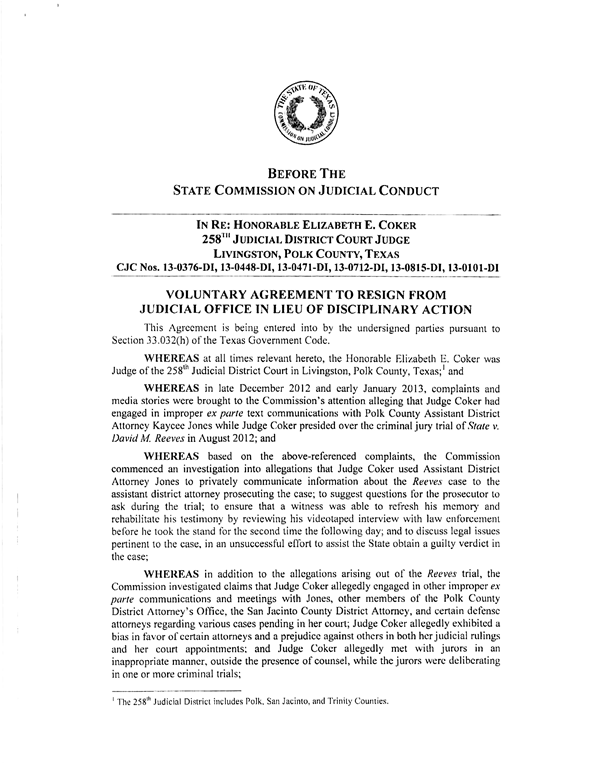
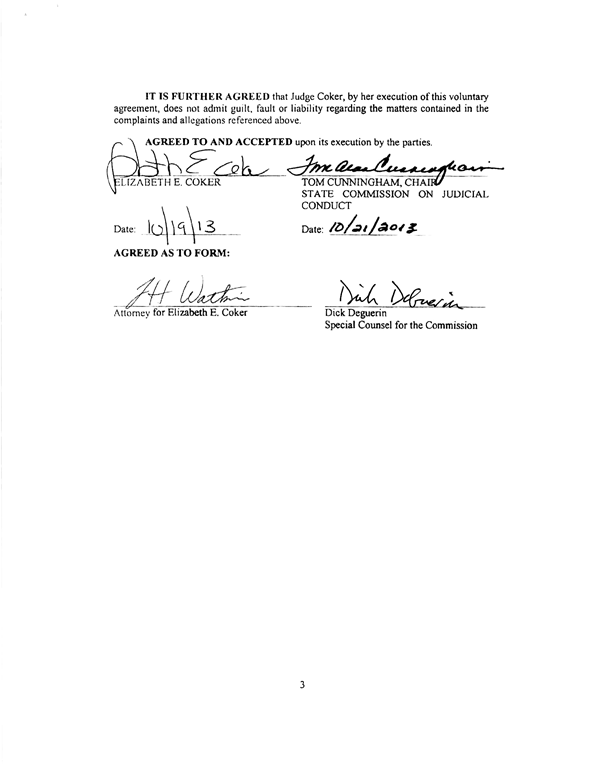
Texas Judge Elizabeth Coker allegedly sent private texts to a prosecutor during a trial she was presiding over, in order to help that attorney obtain a guilty verdict. Although Judge Coker has not admitted to these allegations, she signed a “VOLUNTARY AGREEMENT TO RESIGN FROM JUDICIAL OFFICE IN LIEU OF DISCIPLINARY ACTION” on Monday rather than face further sanction.

According to Coker’s agreement to resign, she allegedly texted then-Assistant District Attorney Kaycee Jones during a trial “to suggest questions for the prosecutor to ask during the trial; to ensure that a witness was able to refresh his memory and rehabilitate his testimony . . . and to discuss legal issues pertinent to the case.” Despite Judge Coker’s alleged breach of judicial impartiality, Jones was unsuccessful in obtaining a conviction.

This incident aside, Jones successfully defeated a longtime incumbent judge to join Judge Corker on the Texas bench. She was sworn into her new judicial role by Coker. Judge Jones admitted to the texting allegations, acknowledged that communicating secretly with a judge about a pending case was wrong, and apologized for her role in the incident.

Read on...

Outrage: "Cash for Kids": Firms Behind Juvenile Prison Bribes Reach $2.5 Million Settlement in Civil Suit

Two judges who were found guilty of bribing are in prison now.
 
We turn to the latest news in the so-called "kids-for-cash" scandal in Pennsylvania, in which judges took money in exchange for sending juvenile offenders to for-profit youth jails. In 2011, former Luzerne County Judge Mark Ciavarella was convicted of accepting bribes for putting juveniles into detention centers operated by the companies PA Child Care and a sister company, Western Pennsylvania Child Care. Ciavarella and another judge, Michael Conahan, are said to have received $2.6 million for their efforts. Now the private juvenile-detention companies at the heart of the kids-for-cash scandal in Pennsylvania have settled a civil lawsuit for $2.5 million. The state has also passed much-needed reforms aimed at improving its juvenile justice system and ensuring such abuses are not repeated. We are joined in Philadelphia by Marsha Levick, chief counsel of the Juvenile Law Center, which helped expose the corrupt judges and represented the families’ class action suit.

NERMEEN SHAIKH: We turn now to the latest news on the so-called "kids for cash" scandal in Pennsylvania, in which judges took money in exchange for sending thousands of juvenile offenders to for-profit youth jails. In 2011, former Luzerne County Judge Mark Ciavarella was convicted of accepting bribes for putting juveniles into detention centers operated by the companies PA Child Care and a sister company, Western Pennsylvania Child Care. Ciavarella and another judge, Michael Conahan, are said to have received $2.6 million for their efforts.
 
Read on...

How a 1983 Murder Created America's Terrible Supermax-Prison Culture

On Oct. 22, 1983, inmates aligned with the Aryan Brotherhood prison gang murdered two corrections officers at the United States Penitentiary near Marion, Ill. The reverberations from those killings are still being felt in the American prison system. The murders sent Marion into lockdown for 23 years, ushered in the era of the modern Supermax prison, and normalized the chilling idea that the only rational way to deal with violent or notorious prisoners is to lock them up in small, isolated cells and throw away the key.

In 1983 Marion was the toughest penitentiary in the federal prison system. The maximum-security complex housed some of the country’s most violent inmates, and the worst of those were put in Marion’s “control unit.” Getting placed in the control unit was akin to being buried alive. Inmates were confined to their small cells for almost 23 hours a day. When they left their cells, they were shackled, guarded, and under constant surveillance. The conditions there echoed the commandant’s line in The Great Escape: “We have, in effect, put all our rotten eggs in one basket. And we intend to watch that basket very carefully.”

Read on...

Jim Crow II

A history of the fight for voting rights and the movement to restrict them once again.

In 1962, Bernard Lafayette Jr., a slim, erudite, 21-year-old civil rights activist with the Student Nonviolent Coordinating Committee (SNCC), was looking for a new assignment. He’d just finished exams at Nashville’s Fisk University, where he was one of a pioneering group of students who had desegregated Nashville’s lunch counters during the sit-ins and integrated interstate bus travel with the Freedom Rides. During the latter mission, Lafayette was beaten in Birmingham and arrested in Jackson, and he narrowly escaped death when his bus was attacked by white supremacists in Montgomery.

In the summer of 1962, Lafayette visited SNCC’s headquarters in Atlanta. SNCC executive secretary James Forman showed him a large map with tacks in places where the group was active. One place—Selma, Alabama—had a large X over it. SNCC had abandoned the city, Forman told Lafayette, because the organizing work was “too hard.” Only 156 of its 15,000 eligible black residents were registered to vote. “During the past decade,” writes Gary May in Bending Toward Justice, the first history of the Voting Rights Act’s passage in 1965, “only seventy-five blacks—twenty-eight of them college graduates—had tried to register, and all had failed.” Lafayette, one of the unsung heroes of the civil rights movement, departed for Selma that fall.

Read on...

The Scholars Who Shill for Wall Street

Academics get paid by financial firms to testify against Dodd-Frank regulations. What’s wrong with this picture?

Professor Todd Zywicki is vying to be the toughest critic of the Consumer Financial Protection Bureau, the new agency set up by the landmark Dodd-Frank financial reform law to monitor predatory lending practices. In research papers and speeches, Zywicki not only routinely slams the CFPB’s attempts to regulate bank overdraft fees and payday lenders; he depicts the agency as a “parochial” bureaucracy that is “guaranteed to run off the rails.” He has also become one of the leading detractors of the CFPB’s primary architect, Elizabeth Warren, questioning her seminal research on medical bankruptcies and slamming her for once claiming Native American heritage to gain “an edge in hiring.”

Zywicki’s withering arguments against financial reform have earned him guest columns in The Wall Street Journal, The Washington Times and on The New York Times’s website. Lobbyists representing the largest consumer finance companies in the country have cited his writings in letters to regulators, and the number of times he has testified before Congress is prominently displayed on his academic website at the George Mason University School of Law.

Read on...

Men on Domestic Violence: 'Society Empowers Men to Abuse ... I'm Sorry We Failed You'


Editor's Note: A nationwide, month-long letter-writing campaign called #31forMarissa has just finished its third week. The campaign encourages men to write about domestic violence, sharing stories that deal with the action, reaction and inaction of men in their family or community, and the legacy of that behavior. Every single day throughout October, which is Domestic Violence Awareness Month, #31forMarissa will publish these letters of support to Marissa Alexander. The letters will then be sent to Alexander, a Florida woman who was sentenced to 20 years in jail after firing a warning shot at a wall near her abusive husband. She neither hit nor hurt anyone. Below is a compilation of excerpts from this past week’s letters. AlterNet will publish a weekly compilation of the letters. Click  here for more information on the campaign and to read the first full letter.

Join AlterNet as it engages in a conversation across generation, race and gender when it leads a Twitter chat with GlobalGrindNews — another media partner for this campaign — on Thursday, Oct. 24, at 3 P.M. ET.  It will be 140 character conversations on men, domestic violence, engagement, silence, masculinity and rage. 

Read on...

Native-Born Americans More Likely To Commit Crimes Than Immigrants, Study Finds

A Pew Research Center report released last week found that second generation immigrants have “striking similarities” to their native-born, non-Hispanic white counterparts when it comes to committing crime. In fact, when it comes to crime rates, second-generation offenders are merely “catching up” to the native-born population.

Biance E. Bersani conducted the study using data from the Bureau of Labor Statistics National Longitudinal Survey of Youth 1997, and found that criminality peaks at the age of 16 for 25 percent of the native-born population and a little less than 25 percent for second-generation immigrants. Meanwhile, 17 percent of 16 year old first-generation immigrants committed crime. Overall, first-generation immigrants commit crime at a lower rate than second-generation and native-born, non-Hispanic whites.

Read on...