Link to Full Text Article
"Psychedelics are powerful psychoactive substances which alter
consciousness and brain function. Like cannabis, psychedelics have long
been considered prohibited Schedule I substances under the Controlled
Substances Act of 1970. However, via the powerful psychological
experiences they induce, psychedelics are now being shown to be viable
therapeutic alternatives in treating depression, substance use
disorders, and other mental illnesses, and even to enhance the
well-being of healthy individuals...."

Your resource for news, research, opinion and comment in the world of Criminology and Criminal Justice, brought to you by the Criminology Library, Centre for Criminology & Sociolegal Studies, University of Toronto
Showing posts with label decriminalization of drugs. Show all posts
Showing posts with label decriminalization of drugs. Show all posts
Can Drug Regulation Help Tackle Organized Crime?
"A recent report argues that regulating illegal drugs can help governments tackle organized crime, adding to a growing number of voices calling for the decriminalization of personal drug use. But can this momentum turn into real change?
The report, by the Global Commission on Drugs, advances the idea that the illegal drug trade only benefits transnational criminal groups while the countries in which they operate suffer the consequences.
The report’s authors argue that criminal organizations take advantage of drug prohibition as they control, and profit from, every aspect of the production and distribution chain.
Link to the Full Report
"A recent report argues that regulating illegal drugs can help governments tackle organized crime, adding to a growing number of voices calling for the decriminalization of personal drug use. But can this momentum turn into real change?
The report, by the Global Commission on Drugs, advances the idea that the illegal drug trade only benefits transnational criminal groups while the countries in which they operate suffer the consequences.
The report’s authors argue that criminal organizations take advantage of drug prohibition as they control, and profit from, every aspect of the production and distribution chain.
Link to the Full Report
10 Years After Drug Decriminalization Portugal Says Treatment Works Better Than Punishment
AFP reports that 10 years after Portugal decriminalized drug use, and decided to treat addicts instead, that the experiment has worked. Portugal drug law show results ten years on, experts say
LISBON — Health experts in Portugal said Friday that Portugal's decision 10 years ago to decriminalise drug use and treat addicts rather than punishing them is an experiment that has worked. "There is no doubt that the phenomenon of addiction is in decline in Portugal," said Joao Goulao, President of the Institute of Drugs and Drugs Addiction, a press conference to mark the 10th anniversary of the law.The number of addicts considered "problematic" -- those who repeatedly use "hard" drugs and intravenous users -- had fallen by half since the early 1990s, when the figure was estimated at around 100,000 people, Goulao said.
Other factors had also played their part however, Goulao, a medical doctor added.
"This development can not only be attributed to decriminalisation but to a confluence of treatment and risk reduction policies."Portugal's holistic approach had also led to a "spectacular" reduction in the number of infections among intravenous users and a significant drop in drug-related crimes, he added.
15 Million Americans Have Been Arrested Because Pot Is Illegal -- When Will Our Dumb Marijuana Prohibition Be Overturned?
Criminal laws are not an effective way to control marijuana; removing criminal penalties does not lead to increased use; decriminalization creates savings in law enforcement.

The great divide between politicians and the people is showing itself in California where polls show the voters support Proposition 19 and where the mainstream politicians mostly oppose it.
To many Americans, there are few policies more bankrupt than the prohibition on marijuana use, a recognition that a blue-ribbon panel reached four decades ago, urging an emphasis on drug education rather than incarceration.
In 1970, the National Commission on Marijuana and Drug Abuse recommended ending the illegality of marijuana in the United States. The Dutch also had a national commission that reached the same conclusion.
The difference was the Dutch listened to their experts and President Nixon and other American politicians ignored the U.S. experts. Well, the results are in – the experts were right and the politicians were wrong, even on the issue of how many people use marijuana. It turns out prohibition was less successful than decriminalization.
Mexico Looks to Legalization as Drug War Murders Hit 28,000
President joins calls for debate after figures reveal extent of violence since launch of military offensive against cartels in 2006
Mexico's president, Felipe Calderón, has joined calls for a debate on the legalization of drugs as new figures show thousands of Mexicans every year being slaughtered in cartel wars.
![[Alleged drug traffickers stand behind packages of seized marijuana as they are presented to the press in Tijuana, Mexico, Wednesday July 21, 2010. According to the army, the suspects were arrested and the drugs seized from them in Tecate after a joint operation by the army and state police, and more than 100 tons of marijuana have been seized in 2010. (AP Photo/Guillermo Arias)]](https://lh3.googleusercontent.com/blogger_img_proxy/AEn0k_vNzYdWfXYakP0c1ieMJ5Q59X8wKFWWgJ1fa8UXL0lOfwvRIwmeXNZ-Iv2LEQqcxTAAcScI2PsgJ2fbnSXWgxiBmf58iGlsadzrJGrWfRrYZMDndru5Vc-ahN6GWvGt-V3TWpyU=s0-d "mexico-drugs.jpg") Alleged drug traffickers stand behind packages of seized marijuana as they are presented to the press in Tijuana, Mexico, Wednesday July 21, 2010. According to the army, the suspects were arrested and the drugs seized from them in Tecate after a joint operation by the army and state police, and more than 100 tons of marijuana have been seized in 2010. (AP Photo/Guillermo Arias)
Alleged drug traffickers stand behind packages of seized marijuana as they are presented to the press in Tijuana, Mexico, Wednesday July 21, 2010. According to the army, the suspects were arrested and the drugs seized from them in Tecate after a joint operation by the army and state police, and more than 100 tons of marijuana have been seized in 2010. (AP Photo/Guillermo Arias)Calderón's new openness comes amid tremendous pressure to justify a strategy that has been accompanied by the spiraling of horrific violence around the country as the cartels fight each other and the government crack down. Official figures released this week put the number of drug war related murders at 28,000.
DOJ to Issue New Guidelines on Medical Marijuana Busts
By Jeralyn, Section Crime Policy

Bump and Update: Here is the text of the DOJ memo.
The Department of Justice is sending out a three page memo to prosecutors in the 14 states that have legalized medical marijuana with new guidelines for prosecutions. According to unnamed officials,
... [the memo] emphasizes that prosecutors have wide discretion in choosing which cases to pursue, and says it is not a good use of federal manpower to prosecute those who are without a doubt in compliance with state law.
Without a doubt? Sounds like there's some wiggle room. [More...]
At the same time, the officials said, the government will still prosecute those who use medical marijuana as a cover for other illegal activity. The memo particularly warns that some suspects may hide old-fashioned drug dealing or other crimes behind a medical marijuana business.
Read on...New FBI Report: A Pot Arrest Every 37 Seconds in 2008
By Jeralyn,
Read on...
Doesn't sound to me like the "war on drugs" is winding down. Tom
The FBI today released its report (available here) on arrests for 2008. Here's the table (jpg) for all drug arrests. Ryan Grim at Huffington Post has reviewed the report and writes:
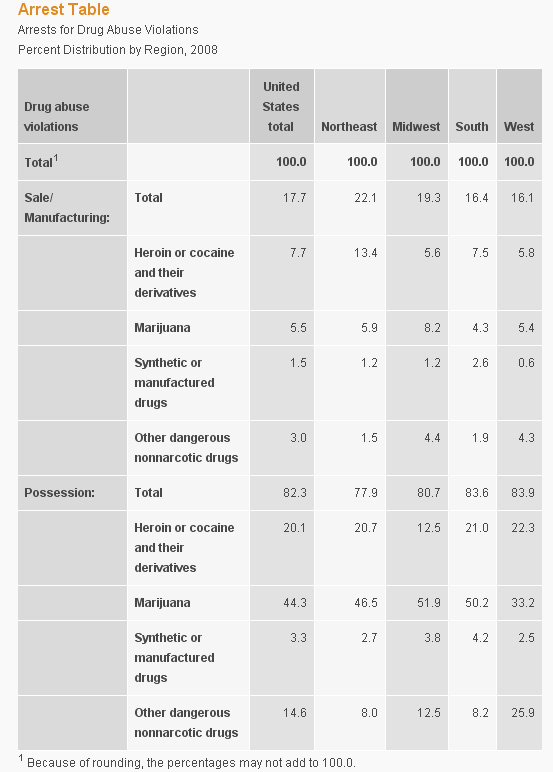
Someone is arrested in the United States for a drug-law violation every 18 seconds, an FBI report released Monday shows. More than four-fifths of those arrests were for possession only and nearly half were for possession of marijuana. Of the 847,863 marijuana arrests -- one every 37 seconds -- 89 percent were for possession alone.
We're wasting vast amounts of money busting drug users. No wonder we're going broke and can't afford health insurance. Remember this report (pdf) by a Harvard University economist finding that legalizing and regulating drugs would inject tens of billions a year into the U.S. economy?
Read on...
Doesn't sound to me like the "war on drugs" is winding down. Tom
Is America Ready to Admit Defeat in Its 40-Year War on Drugs? A wave of decriminalization is sweeping through Latin America
Is America Ready to Admit Defeat in Its 40-Year War on Drugs? Bruno Avangera, a 40-year-old web designer from Tucumán in Argentina, pauses to relight a half-smoked joint of cannabis. Then he speaks approvingly of "progress and the right decision" by the country's seven supreme court judges, who decided last week that prosecuting people for the private consumption of small amounts of narcotics was unconstitutional.
A wave of decriminalization is sweeping through Latin America
"Last year three of my friends were caught smoking a spliff in a park and were treated like traffickers," he said. "They went to court, which took six months. One went to jail alongside murderers. The others were sent to rehab, where they were treated for an addiction they didn't have, alongside serious heroin and crack users. It was pointless and destroyed their lives."
![[Members of the 'Rastrojos' drug trafficking group after surrendering weapons in Carepa province in Medellin, Colombia, May 21, 2009. (Photograph: Fredy Amariles/Reuters)]](https://lh3.googleusercontent.com/blogger_img_proxy/AEn0k_sHImnaqMeQo4UbJL04gq4hLEcPi3I2qiqmFZNauSRRK2EhN_h35LhVmxhDZyDyMOckG0gpV3RA5fF7SMvsKsGaYPT7dMdy8d4CLSPdZTa-sSh57y5XUV7eTuji3X88FFAc4nVRnX-FO9aP-MSe1BFCrw=s0-d "warondrugs_isamericaready.jpg")
Legalizing Pot Makes Lots of Cents for Our Cash-Starved Government
By Paul Armentano, AlterNet. Posted April 14, 2009.
Even the most mainstream figures are now taking the idea of legalizing and taxing pot seriously -- budget-crunched governments should listen.
What could you do with an extra $14 billion dollars? Members of the National Organization for the Reform of Marijuana Laws (NORML) and other likeminded organizations will be asking government officials that very question on Wednesday, April 15th, when they present a mock check to the U.S. Treasury Office.
"We represent the millions of otherwise law-abiding cannabis consumers who are ready, willing, vocal and able to contribute needed tax revenue to America's struggling economy," says Allen St. Pierre, NORML's Executive Director. "All we ask in exchange for our $14 billion is that our government respects our decision to use marijuana privately and responsibly."
But it's not just NORML calling on lawmakers to tax and regulate marijuana. In today's economic climate, the question is: who isn't?
Read on...
Even the most mainstream figures are now taking the idea of legalizing and taxing pot seriously -- budget-crunched governments should listen.
What could you do with an extra $14 billion dollars? Members of the National Organization for the Reform of Marijuana Laws (NORML) and other likeminded organizations will be asking government officials that very question on Wednesday, April 15th, when they present a mock check to the U.S. Treasury Office.
"We represent the millions of otherwise law-abiding cannabis consumers who are ready, willing, vocal and able to contribute needed tax revenue to America's struggling economy," says Allen St. Pierre, NORML's Executive Director. "All we ask in exchange for our $14 billion is that our government respects our decision to use marijuana privately and responsibly."
But it's not just NORML calling on lawmakers to tax and regulate marijuana. In today's economic climate, the question is: who isn't?
Read on...
Marijuana Legalization discourse officially goes Mainstream
by xxdr zombiexx
Fri Feb 27, 2009 at 03:18:32 AM PST
'O the times, they are a changin'.
Andrew Cohen @ CBS News, a very major mainstream media outlet, writes about how the economy is causing states to think about shedding non-violent prisoners from the prion roles, as a cost-saving maneuver.
This lead, naturally, to the discussion of legalizing and regulating marijuana.
The "news" is that this discussion is on something like "CBS".
Read on...
Fri Feb 27, 2009 at 03:18:32 AM PST
'O the times, they are a changin'.
Andrew Cohen @ CBS News, a very major mainstream media outlet, writes about how the economy is causing states to think about shedding non-violent prisoners from the prion roles, as a cost-saving maneuver.
This lead, naturally, to the discussion of legalizing and regulating marijuana.
The "news" is that this discussion is on something like "CBS".
Read on...
Zogby Poll: Majority Support for Taxing and Regulating Marijuana on the West Coast
By Phillip S. Smith, Drug War Chronicle. Posted February 20, 2009.
58% of West Coast respondents agreed that marijuana should be "taxed and regulated like alcohol and cigarettes."
Support for taxing and regulating marijuana has climbed above 50% on the West Coast, according to a national poll of 1,053 registered voters. The poll was conducted by Zogby International and was commissioned by California NORML and Oakland's Oaksterdam University.
The poll found that 58% of West Coast respondents agreed that marijuana should be "taxed and regulated like alcohol and cigarettes." Only 36% of West Coast respondents disagreed.
Read on...
58% of West Coast respondents agreed that marijuana should be "taxed and regulated like alcohol and cigarettes."
Support for taxing and regulating marijuana has climbed above 50% on the West Coast, according to a national poll of 1,053 registered voters. The poll was conducted by Zogby International and was commissioned by California NORML and Oakland's Oaksterdam University.
The poll found that 58% of West Coast respondents agreed that marijuana should be "taxed and regulated like alcohol and cigarettes." Only 36% of West Coast respondents disagreed.
Read on...
Pot Wins in a Landslide: A Thundering Rejection of America's Longest War
By Rob Kampia, AlterNet. Posted November 5, 2008.
Voters dealt what may be a fatal blow to America's longest-running and least-discussed war -- the war on marijuana.
On Tuesday, largely under the radar of the pundits and political chattering classes, voters dealt what may be a fatal blow to America's longest-running and least-discussed war -- the war on marijuana.
Michigan voters made their state the 13th to allow the medical use of marijuana by a whopping 63 percent to 37 percent, the largest margin ever for a medical marijuana initiative. And by 65 percent to 35 percent, Massachusetts voters decriminalized the possession of up to an ounce of marijuana, replacing arrests, legal fees, court appearances, the possibility of jail and a lifelong criminal record with a $100 fine, much like a traffic ticket, that can be paid through the mail.
Read on...
Pot may have had some victories on Tuesday but the defeat of Proposition 5 in Californai was a setback. Tom
Voters dealt what may be a fatal blow to America's longest-running and least-discussed war -- the war on marijuana.
On Tuesday, largely under the radar of the pundits and political chattering classes, voters dealt what may be a fatal blow to America's longest-running and least-discussed war -- the war on marijuana.
Michigan voters made their state the 13th to allow the medical use of marijuana by a whopping 63 percent to 37 percent, the largest margin ever for a medical marijuana initiative. And by 65 percent to 35 percent, Massachusetts voters decriminalized the possession of up to an ounce of marijuana, replacing arrests, legal fees, court appearances, the possibility of jail and a lifelong criminal record with a $100 fine, much like a traffic ticket, that can be paid through the mail.
Read on...
Pot may have had some victories on Tuesday but the defeat of Proposition 5 in Californai was a setback. Tom
Hell Freezes Over: White House Drug Czar Backs Decriminalization
WASHINGTON - October 27 - The Marijuana Policy Project today congratulated White House "drug czar" John Walters for backing a Mexican government proposal that would remove criminal penalties for possession of small amounts of marijuana.
"I can't believe I'm actually saying this, but John Walters is right," said MPP executive director Rob Kampia. "We heartily second his support for eliminating criminal penalties for marijuana users in Mexico, and look forward to working with him to end such penalties in the U.S. as well."
Read on...
This drug czar will probably be out of work by Friday....Tom
"I can't believe I'm actually saying this, but John Walters is right," said MPP executive director Rob Kampia. "We heartily second his support for eliminating criminal penalties for marijuana users in Mexico, and look forward to working with him to end such penalties in the U.S. as well."
Read on...
This drug czar will probably be out of work by Friday....Tom
The Great Reagan Pyramid Scheme Comes Crashing Down
by Juan Cole
The Republican Party that Nixon invented melded the moneyed classes of the Northeast with the white evangelicals of the South. This odd couple went on to simultaneously steal from and oppress the rest of us. The moneyed classes were happy to let the New Puritans impose their stringent morality, since they could always just buy any licentiousness they wanted, regardless of the law. And the New Puritans were so consumed with cultural issues such as homosexuality, abortion, school prayer and (yes) fighting school desegregation that they were happy to let the northeastern Money Men waltz off with a lion's share of the country's resources, consigning most Americans to stagnant wages and increasing debt. The Reagan revolution consolidated this alliance and brought some conservative Catholic workers into it.
These domestic policies at home were complemented by wars and belligerence abroad, which further took the eye of the public off the epochal bank robbery being conducted by the American neo-Medicis, and which were a useful way of throwing billions in government tax revenue to the military-industrial complex, which in turn funded the think tanks and reelection campaigns of the right wing politicians. The Reagan fascination with private armies and funding anti-communist death squads contributed mightily to the creation of al-Qaeda, blowback from which fuelled even bigger Pentagon budgets, spiralling upward and feeding on itself. Terrorism is much better than Communism as a bogey man, since you can just intimate that there are a handful of dangerous people out there somewhere, and force the public to pay over $1 trillion to combat them. In fact, of course, less US interventionism abroad would create less blowback, and genuine threats are better addressed through good police work by multilingual FBI agents than by a $700 billion Pentagon budget.
Read on...
Juan Cole of the blog Informed Comment opines on regulation, the war on drugs, and decriminalization of drugs. An interesting take on how the U.S. and world got in the economic and social mess it is in. Tom
The Republican Party that Nixon invented melded the moneyed classes of the Northeast with the white evangelicals of the South. This odd couple went on to simultaneously steal from and oppress the rest of us. The moneyed classes were happy to let the New Puritans impose their stringent morality, since they could always just buy any licentiousness they wanted, regardless of the law. And the New Puritans were so consumed with cultural issues such as homosexuality, abortion, school prayer and (yes) fighting school desegregation that they were happy to let the northeastern Money Men waltz off with a lion's share of the country's resources, consigning most Americans to stagnant wages and increasing debt. The Reagan revolution consolidated this alliance and brought some conservative Catholic workers into it.
These domestic policies at home were complemented by wars and belligerence abroad, which further took the eye of the public off the epochal bank robbery being conducted by the American neo-Medicis, and which were a useful way of throwing billions in government tax revenue to the military-industrial complex, which in turn funded the think tanks and reelection campaigns of the right wing politicians. The Reagan fascination with private armies and funding anti-communist death squads contributed mightily to the creation of al-Qaeda, blowback from which fuelled even bigger Pentagon budgets, spiralling upward and feeding on itself. Terrorism is much better than Communism as a bogey man, since you can just intimate that there are a handful of dangerous people out there somewhere, and force the public to pay over $1 trillion to combat them. In fact, of course, less US interventionism abroad would create less blowback, and genuine threats are better addressed through good police work by multilingual FBI agents than by a $700 billion Pentagon budget.
Read on...
Juan Cole of the blog Informed Comment opines on regulation, the war on drugs, and decriminalization of drugs. An interesting take on how the U.S. and world got in the economic and social mess it is in. Tom
Subscribe to:
Posts (Atom)