More than 2 million adults are incarcerated in U.S. prisons, and each
year more than 700,000 leave federal and state prisons and return to
communities. Unfortunately, within three years, 40 percent will be
reincarcerated. One reason for this is that ex-offenders lack the
knowledge, training, and skills to support a successful return to
communities. Trying to reduce such high recidivism rates is partly why
states devote resources to educating and training individuals in prison.
This raises the question of how effective — and cost-effective —
correctional education is — an even more salient question given the
funding environment states face from the 2008 recession and its
continuing aftermath. With funding from the Second Chance Act of 2007,
the Bureau of Justice Assistance, U.S. Department of Justice, asked RAND
to help answer this question as part of a comprehensive examination of
the current state of correctional education for incarcerated adults and
juveniles. The RAND team conducted a systematic review of correctional
education programs for incarcerated adults and juveniles. This included a
meta-analysis on correctional education's effects on recidivism and
postrelease employment outcomes for incarcerated adults, as well as a
synthesis of evidence on programs for juveniles. The study also included
a nationwide survey of state correctional education directors to
understand how correctional education is provided today and the
recession's impact. The authors also compared the direct costs of
correctional education with those of reincarceration to put the
recidivism findings into a broader context.
Read on...

Your resource for news, research, opinion and comment in the world of Criminology and Criminal Justice, brought to you by the Criminology Library, Centre for Criminology & Sociolegal Studies, University of Toronto
Showing posts with label corrections. Show all posts
Showing posts with label corrections. Show all posts
Correctional Service Canada Launches New Research Website
Research at the Correctional Service of Canada (CSC) helps make direct links between research findings and implications for our institutions, community sites and the public. CSC research helps offenders work towards successful reintegration and assists staff in identifying effective strategies to work safely and efficiently. Check out our Research Spotlight for new research that will be highlighted throughout the year.
CSC's broad research portfolio includes projects in areas like:
We use quantitative and qualitative methodological approaches, including data analysis and interviews with staff and offenders. Our studies can involve a quick, data-driven profile or can consist of a multi-year and multi-phase research study. Our research often involves CSC staff from national and regional headquarters, community sites and institutions. Results of our research are shared with CSC employees, other government departments, provincial/territorial counterparts, partner organizations, universities and academic journals, and the general public.
Read on...
- Offender population profiles
- Mental health issues – screening, population profiles and treatment
- Women and Aboriginal offender needs
- Institutional and community operations and security
We use quantitative and qualitative methodological approaches, including data analysis and interviews with staff and offenders. Our studies can involve a quick, data-driven profile or can consist of a multi-year and multi-phase research study. Our research often involves CSC staff from national and regional headquarters, community sites and institutions. Results of our research are shared with CSC employees, other government departments, provincial/territorial counterparts, partner organizations, universities and academic journals, and the general public.
Read on...
What Happens When the Amish Go to Prison?
Do they have to shave and wear orange jumpsuits?
Sixteen members of a breakaway Amish sect were convicted of hate crimes
in Ohio on Thursday. The jury found them guilty of violently shaving
the hair and beards of disfavored members of the community, and they now
face up to 20 years in prison. How do American prisons accommodate the
old-fashioned religious practices of Amish people?
They don’t, for the most part. State and federal prison systems don’t
have special regulations for the tiny number of Amish serving extended
sentences, many of them for sex offenses.
The Amish reject most modern technology and dress. In prison, however,
their cells have electric lighting and climate control, they wear orange jumpsuits,
and they are transported between the prison and the courthouse in vans,
just like other inmates. Prison administrators generally require
prisoners to keep their beards trimmed, but wardens sometimes allow
exceptions for religious reasons.
U.S. prisons are required to accommodate religious beliefs under the Religious Land Use and Institutionalized Persons Act,
but inmates’ religious freedoms are tempered by security and cost
concerns. Striking this balance has proven challenging for judges. In
the case of facial hair, for example, courts have struck down outright beard bans,
but agreed with wardens that excessively long or unkempt facial hair
prevents guards from quickly identifying inmates. Prisoners who require
special meals have also met with mixed responses. An inmate can demand a
halal meal, but it is often just the prison’s vegetarian meal, because
the facility refuses to pay the added expense of halal butchering.
Read on...
Read on...
The Affordable Care Act: Implications for Public Safety and Corrections Populations
Many people in correctional institutions have faced barriers obtaining needed health and behavioral health care services in the community either prior to their incarceration or upon reentry following
incarceration. One-third to three-quarters of men booked into jails in ten major cities in 2010 were not covered by any type of health insurance.1 This is largely because of high rates of unemployment and narrow Medicaid eligibility criteria. Unemployment limits access to employer-based health plans and the ability to purchase private insurance or pay health costs out-of-pocket. Additionally, people who have been incarcerated face enduring barriers to employment both because of legal barriers and
the stigma associated with having a felony conviction. Consequently, they also face enduring challenges obtaining employer-based health insurance.2, 3 Medicaid is an alternative for some individuals, but only for those who meet income requirements and who are also either pregnant, have dependent children, or are severely disabled.4
The Affordable Care Act
The Affordable Care Act (ACA) signed into law by the President in 2011 potentially can aid individuals who are at risk for incarceration and those who have been incarcerated through provisions that allow states to expand eligibility for Medicaid. The ACA creates new mechanisms for uninsured people to obtain coverage for physical and behavioral health care. First, by 2014 each state must have a health insurance exchange that will act as a regulated health insurance marketplace whereby
uninsured individuals with incomes between 133% and 400% of the federal poverty limit can purchase coverage. Individuals will receive tax credits on a sliding scale to offset the cost of this coverage.5
Read on...
incarceration. One-third to three-quarters of men booked into jails in ten major cities in 2010 were not covered by any type of health insurance.1 This is largely because of high rates of unemployment and narrow Medicaid eligibility criteria. Unemployment limits access to employer-based health plans and the ability to purchase private insurance or pay health costs out-of-pocket. Additionally, people who have been incarcerated face enduring barriers to employment both because of legal barriers and
the stigma associated with having a felony conviction. Consequently, they also face enduring challenges obtaining employer-based health insurance.2, 3 Medicaid is an alternative for some individuals, but only for those who meet income requirements and who are also either pregnant, have dependent children, or are severely disabled.4
The Affordable Care Act
The Affordable Care Act (ACA) signed into law by the President in 2011 potentially can aid individuals who are at risk for incarceration and those who have been incarcerated through provisions that allow states to expand eligibility for Medicaid. The ACA creates new mechanisms for uninsured people to obtain coverage for physical and behavioral health care. First, by 2014 each state must have a health insurance exchange that will act as a regulated health insurance marketplace whereby
uninsured individuals with incomes between 133% and 400% of the federal poverty limit can purchase coverage. Individuals will receive tax credits on a sliding scale to offset the cost of this coverage.5
Read on...
Jails don’t keep people out of jail
Collectively, we have nearly 10 decades of experience in the area of corrections and conditional release. There are many issues we have disagreed over, but we are united in our concerns with the direction of the Harper government’s “tough on crime” agenda.
In a country that prides itself on fairness, compassion and the pursuit of equality, why do we accept the idea that community safety will be enhanced through increased incarceration?
At both the federal and provincial levels, Canadian jails are overcrowded. It is becoming common to see double- and triple-bunking of inmates in cells designed for one. This overcrowding limits access to already scarce rehabilitative programming and increases the incidence of institutional violence. The fastest-growing portions of the inmate population continue to be those most marginalized within our society: the mentally ill, women and aboriginals. Decades of reports have detailed our correctional systems’ failure to reasonably address the needs of these offenders and limit their numbers.
This is an opinion piece from the Globe and Mail. Tom
Miami-Dade's Inmate Idol Turns Jailbirds Into Songbirds
Annual contest held at detention center to find talented prisoners

Simon, Ellen, Randy and Kara may have been replaced by steely-eyed prison guards, and "You're Going to Hollywood" was replaced with "Back to Your Cell," but for the inmates at the Metro West Detention Center in Miami-Dade, an opportunity to show off their vocal stylings was too good to pass up.
Yesterday, the prison held its 2nd annual Inmate Idol Contest, pitting convicted felons and inmates awaiting trial against each other in a singing and rapping battle.
Corrections officers served as judges as orange jumpsuit-clad jailbirds sang about religion, domestic violence and love.
What Makes a Prison "State of the Art"?
Posted Monday, Nov. 16, 2009, at 7:44 PM ET
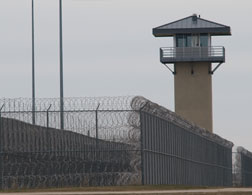
Federal officials visited a correctional center in Thomson, Ill., on Monday, to see if it might be appropriate for housing detainees from Guantanamo Bay. A statement from the governor's office described the prison as a "virtually vacant, state of the art facility." What makes a prison "state of the art?"
Federal officials visited a correctional center in Thomson, Ill., on Monday, to see if it might be appropriate for housing detainees from Guantanamo Bay. A statement from the governor's office described the prison as a "virtually vacant, state of the art facility." What makes a prison "state of the art?"
A triangle shape, in part. Modern prisons are generally designed with three sides, no more than two stories of cells lining the perimeter, and communal activities like dining in the center. The shape supposedly allows guards stationed in the middle to see every corner of the building, with better sight lines than you'd get from a rectangular layout. (The triangle design came into fashion in the United States after World War II and soon spread to other countries.)
The High Cost of Empty Prisons
LAST Wednesday, changes to New York’s notorious Rockefeller drug laws went into effect, allowing judges to shorten the prison terms of some nonviolent offenders. This measure will further reduce New York’s prison population, which has already declined, in the past 10 years, from about 71,600 in 1999 to about 59,300 today. (The state’s crime rate also dropped substantially during that time.)
Nevertheless, mainly because of opposition from the correction officers’ union and politicians from the upstate areas where most of our correctional facilities are, the state has been slow to close prisons. It was not until earlier this year that policymakers in Albany, confronted with fiscal crisis, mustered the will to shut three prison camps and seven prison annexes — a total of about 2,250 prison beds — in a move that is expected to save $52 million over the next two years.
Read on...
Just in case you missed this editorial from Sunday's New York Times. Tom
Update on The Fiscal Crisis in Corrections
On July 29, Vera released The Fiscal Crisis in Corrections: Rethinking Policies and Practices, which highlights the impact of state budget cuts on departments of corrections. This timely update is prompted by information about the influence of stimulus funds in a number of states and new budget information from four additional states. The revised report, which is based on survey responses from 37 states, finds at least 26 states have reversed the trend of recent decades and cut corrections spending. In three states—Kansas, Nebraska, and South Dakota—officials reduced initial general fund appropriations knowing that a portion of the reduction would be made up by federal stimulus funds. Thus, although general fund appropriations decreased by double-digits in these states, the actual operational impacts were smaller. Other updated findings include:
The Fiscal Crisis in Corrections: Rethinking Policies and Practices was funded by the Public Safety Performance Project of the Pew Center on the States. To download the revised report visit Vera’s web site at http://www.vera.org/content/fiscal-crisis-corrections-rethinking-policies-and-practices. The Vera Institute of Justice is an independent nonprofit organization that combines expertise in research, demonstration projects, and technical assistance to help leaders in government and civil society improve the systems people rely on for justice and safety.
|
To learn more about the Vera Institute of Justice, visit www.vera.org. |


This e-mail was sent by The Vera Institute of Justice, located at 233 Broadway, 12th Floor, New York, NY 10279 (United States). To receive no further e-mails, please click here or reply to this e-mail with "unlist" in the Subject line.
The Fiscal Crisis in Corrections: Rethinking Policies and Practices
New Report from the Vera Institute
Declining revenues from the worst fiscal crisis in decades are forcing many states to make across the board budget cuts. Even departments of corrections and public safety, long considered off limits, are affected.
A new report from Vera’s Center on Sentencing and Corrections highlights the impact of these cuts and the ways officials are rising to the challenge of lowering spending while maintaining—and in some cases enhancing—public safety. The findings are based on a survey of enacted FY2010 state budgets and recent legislation, which found at least 22 states reversing the trend of recent decades and cutting corrections spending.
Findings include:
- At least 28 states are reducing staff, instituting hiring freezes, reducing salaries or benefits, and/or eliminating pay increases.
- An increasing number of states are identifying groups of people who can be safely released after serving shorter terms behind bars.
- At least 20 states are closing facilities/reducing beds or delaying expansion/construction of new facilities.
This report was funded by the Public Safety Performance Project of the Pew Center on the States.
To download this report visit Vera’s web site at www.vera.org/content/fiscal-crisis-corrections-rethinking-policies-and-practices-1.
Incarceration of Aboriginal people in adult correctional services
Published by Statistics Canada
In 2007/2008, Aboriginal adults accounted for 22% of admissions to sentenced custody, while representing 3% of the Canadian population.
Age, level of education, and employment status can only partially explain the representation of Aboriginal adults incarcerated in Canadian prisons, according to a new study that used data from the Integrated Correctional Service Survey and the 2006 Census to analyze factors that could be contributing to the representation of Aboriginal adults in custody.
Read on...
In 2007/2008, Aboriginal adults accounted for 22% of admissions to sentenced custody, while representing 3% of the Canadian population.
Age, level of education, and employment status can only partially explain the representation of Aboriginal adults incarcerated in Canadian prisons, according to a new study that used data from the Integrated Correctional Service Survey and the 2006 Census to analyze factors that could be contributing to the representation of Aboriginal adults in custody.
Read on...
One in Every 31 Adults in Prison; Prison Spending Outpaces All but Medicaid
One in every 31 adults, or 7.3 million Americans, is in prison, on parole or probation, at a cost to the states of $47 billion in 2008, according to a new study.
Correction spending is outpacing budget growth in education, transportation and public assistance, based on state and federal data.
Only Medicaid spending grew faster than state corrections spending, which quadrupled in the past two decades, according to the report today by the Pew Center on the States, the first breakdown of spending in confinement and supervision in the past seven years.
Read on...
Correction spending is outpacing budget growth in education, transportation and public assistance, based on state and federal data.
Only Medicaid spending grew faster than state corrections spending, which quadrupled in the past two decades, according to the report today by the Pew Center on the States, the first breakdown of spending in confinement and supervision in the past seven years.
Read on...
Correction Officers Accused of Letting Inmates Run Rikers Island Jail
Guards reputedly sent inmates to intimidate, threaten and silence uncooperative prisoners with brute force. Inmates were ordered to turn over money, and their every move, including when they could use the bathroom, was controlled. If word of an assault got out, the guards would allegedly orchestrate a cover-up.
In fact, prosecutors said, a unit for teenagers on Rikers Island was run much like an organized-crime family — and two correction officers were the bosses.
Those accusations were made on Thursday in State Supreme Court in the Bronx, where three Rikers Island correction officers were charged in connection with the ring, whose crimes, prosecutors said, reached a climax with the beating death of an 18-year-old inmate.
Read on...
In fact, prosecutors said, a unit for teenagers on Rikers Island was run much like an organized-crime family — and two correction officers were the bosses.
Those accusations were made on Thursday in State Supreme Court in the Bronx, where three Rikers Island correction officers were charged in connection with the ring, whose crimes, prosecutors said, reached a climax with the beating death of an 18-year-old inmate.
Read on...
Adult and Youth Corrections: Key Indicators
Statistics Canada. The Daily
Canada's incarceration rate in 2007/2008 rose by 2% from the previous year, the third consecutive annual increase. The gain was driven by the growing number of adults being held in remand in provincial/territorial jails while awaiting trial or sentencing.
Recent increases in the incarceration rate follow a period of relatively steady decline from 1996/1997 to 2004/2005.
On any given day in 2007/2008, an average of 36,330 adults and 2,018 youth aged 12 to 17 years were in custody in Canada, for a total of 38,348 inmates. In terms of a rate, this was 117 people in custody for every 100,000 population.
Canada's incarceration rate tends to be higher than those in most Western European countries, yet far lower than that of the United States. For instance, in 2007, Sweden had a rate of 74 people in custody per 100,000 population. In contrast, the rate in the United States for adults alone was 762. (The United States excludes youth from its rate.)
Read on...
Canada's incarceration rate in 2007/2008 rose by 2% from the previous year, the third consecutive annual increase. The gain was driven by the growing number of adults being held in remand in provincial/territorial jails while awaiting trial or sentencing.
Recent increases in the incarceration rate follow a period of relatively steady decline from 1996/1997 to 2004/2005.
On any given day in 2007/2008, an average of 36,330 adults and 2,018 youth aged 12 to 17 years were in custody in Canada, for a total of 38,348 inmates. In terms of a rate, this was 117 people in custody for every 100,000 population.
Canada's incarceration rate tends to be higher than those in most Western European countries, yet far lower than that of the United States. For instance, in 2007, Sweden had a rate of 74 people in custody per 100,000 population. In contrast, the rate in the United States for adults alone was 762. (The United States excludes youth from its rate.)
Read on...
Subscribe to:
Posts (Atom)