Yesterday was a bad day for pretty much anyone who cares about racial
equality, voting rights, police violence and that vague thing we call
“justice.” But leave it to the brilliant Angela Davis to turn the blow
into a rallying cry to counteract violence — both institutional and
intimate.
First, here’s what happened. After an intense lobbying campaign by
the police union — officially called the Fraternal Order of Police;
you’ll see why the name is important later — the senate blocked
President Obama’s nomination of Debo P. Adegbile to be the chief of the
Justice Department’s Civil Rights Division. Adegbile, who headed the
NAACP’s legal defense fund for years, was tarred by the police’s union,
and subsequently by Democrat and Republican senators alike, for having
helped represent journalist and Black Panther member Mumia Abu-Jamal in
an appeal of his death sentence for allegedly killed a Philadelphia
police officer.
No matter that Adebgile and the team won the appeal. Or that
Abu-Jamal’s case is riddled with inconsistencies. Or that Adebgile has
been a leading champion of voting rights and civil rights for decades.
Read on...

Your resource for news, research, opinion and comment in the world of Criminology and Criminal Justice, brought to you by the Criminology Library, Centre for Criminology & Sociolegal Studies, University of Toronto
Showing posts with label justice. Show all posts
Showing posts with label justice. Show all posts
14 Shocking Global Human Rights Violations of 2013
From rampant violence and sexual abuse against women, to the commission of crimes against humanity by dictators, 2013 was a year filled with pervasive human rights violations worldwide. Government response to the atrocities was disappointing, marked by lack of transparency and accountability, blatant malevolence and a disregard for human life. Yet, international human rights advocates remained tenacious, inciting massive protests and public condemnation in an effort to demand an end to the culture of impunity. Here are some of most outrageous travesties of justice that captured our attention and had us up in arms this year.
1. Unsafe labor conditions in Bangladesh led to world’s worst garment industry tragedy as thousands died in horrific building collapse.
Read on...
King's Easter epistle on civil disobedience
Fifty years ago, the civil rights leader violated an injunction forbidding him to pray, sing or march in public in Birmingham, Ala. And he told his critics why.
This year is the 50th anniversary of the Rev. Martin Luther King Jr.'s decision to violate an injunction forbidding him to pray, sing or march in public in Birmingham, Ala. On Good Friday 1963 (which fell on April 12 that year), King led a march from the 16th Street Baptist Church (where four black children would be killed in a bombing five months later), heading toward City Hall. He was almost immediately arrested, charged with violating a court order and taken to the Birmingham jail.As he sat in jail on Easter Sunday and the days that followed, he wrote his "Letter From Birmingham Jail" to a group of moderate white clergymen who had issued a "call to unity" to civil rights activists, urging them to pursue legal remedies rather than engage in nonviolent protests. Anyone who hasn't read King's response lately (and most of us who have) would benefit from spending a few minutes reading it this Easter weekend.
King had journeyed to Birmingham to help lead an economic boycott of segregated stores, where blacks could shop but not work or eat. As he put it, "I am in Birmingham because injustice is here," and "injustice anywhere is a threat to justice everywhere."
Read on...
10 Ways the Drug War Is Causing Massive Collateral Damage to Our Society
The war on drugs is America’s longest war. It has been 40-plus years
since Nixon launched our modern “war on drugs” and yet drugs are as
plentiful as ever. While the idea that we can have a “drug-free society”
is laughable, the disastrous consequences of our drug war are dead
serious. While it might not be obvious, the war on drugs touches and
destroys so many of the issues we care about and the values we hold.
Below are 10 collateral consequences of the drug war and reasons we need
to find an exit strategy from this unwinnable war.
1. Racial Injustice
The war on drugs is built on racial injustice. Despite roughly equal rates of drug use and sales, African-American men are arrested at 13 times the rate of white men on drug charges in the U.S. -- with rates of up to 57 times in some states. African Americans and Latinos together make up 29 percent of the total U.S. population, but more than 75 percent of drug law violators in state and federal prisons.
Read on...
1. Racial Injustice
The war on drugs is built on racial injustice. Despite roughly equal rates of drug use and sales, African-American men are arrested at 13 times the rate of white men on drug charges in the U.S. -- with rates of up to 57 times in some states. African Americans and Latinos together make up 29 percent of the total U.S. population, but more than 75 percent of drug law violators in state and federal prisons.
Read on...
Ontario court reinforces laws to protect women from harrassment
In an important decision for the legal treatment of abused women,
Ontario’s top court has found that stalking and verbal threats can be
just as severe as physical attacks.
The province’s Court of Appeal upheld a sentence of 5 1/2 years in the case of a man who subjected a woman he had recently met to a barrage of harassing phone calls and letters, including two sent while he was in jail awaiting trial.
Patrick James Doherty argued that, because he did not assault his victim, he should receive a lesser sentence. The court rejected his reasoning.
The victim “suffered mentally and physically as a result of the appellant’s harassment. She lost weight, lost sleep and was anxious and worried about what he may do to her,” wrote Justice Dennis O’Connor of the court’s unanimous decision. “The impact on her was magnified each time he ignored her pleas to stop, the police warnings and the court orders.”
It all began in November of last year when Agnieszka Mikulska posted a classified advertisement online, seeking a roommate for her Kitchener, Ont., apartment. Mr. Doherty responded. Initially polite, he became angry when Ms. Mikulska picked someone else to live with her.
Read on...
The province’s Court of Appeal upheld a sentence of 5 1/2 years in the case of a man who subjected a woman he had recently met to a barrage of harassing phone calls and letters, including two sent while he was in jail awaiting trial.
Patrick James Doherty argued that, because he did not assault his victim, he should receive a lesser sentence. The court rejected his reasoning.
The victim “suffered mentally and physically as a result of the appellant’s harassment. She lost weight, lost sleep and was anxious and worried about what he may do to her,” wrote Justice Dennis O’Connor of the court’s unanimous decision. “The impact on her was magnified each time he ignored her pleas to stop, the police warnings and the court orders.”
It all began in November of last year when Agnieszka Mikulska posted a classified advertisement online, seeking a roommate for her Kitchener, Ont., apartment. Mr. Doherty responded. Initially polite, he became angry when Ms. Mikulska picked someone else to live with her.
Read on...
Goodbye, Liberty! 10 Ways Americans Are No Longer Free
Our most fundamental rights, to life, liberty and the pursuit of
happiness, are under assault. But the adversary is Big Wealth, not Big
Government as conservatives like to claim. Consider:
Life? The differences in life expectancy between wealthier and lower-income Americans are increasing, not decreasing.
Liberty? Digital corporations are assaulting our privacy, while banks trap us in indebtedness that approaches indentured servitude. The shrunken ranks of working Americans are being robbed of their essential liberties – including the right to use the bathroom.
The pursuit of happiness? Social mobility in the United States is dead. Career choices are increasingly limited. As for working hard and earning more, consider this: Between 1969 and 2008 the average US income went up by $11,684. How much of that went to the top 10? All of it. Income for the remaining 90 percent actually went down.
These changes didn't just happen. Wealthy individuals and corporations made it happen – and they're still at it. Meanwhile, Corporate America's wholesale theft of your individual liberties has been rebranded as a fight for … the corporation's individual liberty.
Read on...
Life? The differences in life expectancy between wealthier and lower-income Americans are increasing, not decreasing.
Liberty? Digital corporations are assaulting our privacy, while banks trap us in indebtedness that approaches indentured servitude. The shrunken ranks of working Americans are being robbed of their essential liberties – including the right to use the bathroom.
The pursuit of happiness? Social mobility in the United States is dead. Career choices are increasingly limited. As for working hard and earning more, consider this: Between 1969 and 2008 the average US income went up by $11,684. How much of that went to the top 10? All of it. Income for the remaining 90 percent actually went down.
These changes didn't just happen. Wealthy individuals and corporations made it happen – and they're still at it. Meanwhile, Corporate America's wholesale theft of your individual liberties has been rebranded as a fight for … the corporation's individual liberty.
Read on...
In challenge to Ottawa, judge refuses to impose mandatory sentence

Legislation that would give police and spies easier access to information about Internet users threatens to turn Canada into a surveillance society, the Official Opposition says.
“We are against this bill and we will fight this bill all the way,” NDP MP Charlie Angus told reporters in Ottawa. “Canadians are not criminals.”
The bill tabled Tuesday in the House of Commons would allow authorities access to Internet subscriber information – including name, address, telephone number and email address – without first getting a court's go-ahead.
The proposed measures pit the desire of intelligence and law-enforcement officials to have ready access to information about people online against the individual's right to privacy.
Turning Poverty Into an American Crime
I completed the manuscript for Nickel and Dimed in a time of seemingly boundless prosperity. Technology innovators and venture capitalists were acquiring sudden fortunes, buying up McMansions like the ones I had cleaned in Maine and much larger. Even secretaries in some high-tech firms were striking it rich with their stock options. There was loose talk about a permanent conquest of the business cycle, and a sassy new spirit infecting American capitalism. In San Francisco, a billboard for an e-trading firm proclaimed, “Make love not war,” and then—down at the bottom—“Screw it, just make money.”
When Nickel and Dimed was published in May 2001, cracks were appearing in the dot-com bubble and the stock market had begun to falter, but the book still evidently came as a surprise, even a revelation, to many. Again and again, in that first year or two after publication, people came up to me and opened with the words, “I never thought...” or “I hadn’t realized...”
Read on...
When Nickel and Dimed was published in May 2001, cracks were appearing in the dot-com bubble and the stock market had begun to falter, but the book still evidently came as a surprise, even a revelation, to many. Again and again, in that first year or two after publication, people came up to me and opened with the words, “I never thought...” or “I hadn’t realized...”
Read on...
Does the Justice System Actually Dispense Justice?
Or Does it Serve the Powers-That-Be, Like the Other Branches of Government?
In 2000, Supreme Court Justice Ruth Ginsburg did something unprecedented. In her dissenting opinion in the Bush v. Gore case (which threw the election to Bush), Ginsburg ended her opinion with the words "I dissent".
Believe it or not, this is a big deal. The standard etiquette for a judge - especially a supreme court justice - writing a dissenting opinion is to end with the phrase, "I respectfully dissent". By leaving out the word "respectfully", Ginsburg dropped normal judicial etiquette to protest an unconstitutional decision, more or less quietly declaring that a coup had occurred.
Supreme court justice Antonin Scalia said that he doesn't care what the legislature intended when it passes a law. This is contrary to hundreds of years of American law, as legislative intent is supposed to be examined whenever legislation is ambiguous, or does not appear to directly or adequately address a particular issue, or when there appears to have been a legislative drafting error.
Scalia also went duck-hunting with Dick Cheney, even though the judicial and executive branches are supposed to keep their distance as part of the separation of powers.
Read on...
In 2000, Supreme Court Justice Ruth Ginsburg did something unprecedented. In her dissenting opinion in the Bush v. Gore case (which threw the election to Bush), Ginsburg ended her opinion with the words "I dissent".
Believe it or not, this is a big deal. The standard etiquette for a judge - especially a supreme court justice - writing a dissenting opinion is to end with the phrase, "I respectfully dissent". By leaving out the word "respectfully", Ginsburg dropped normal judicial etiquette to protest an unconstitutional decision, more or less quietly declaring that a coup had occurred.
Supreme court justice Antonin Scalia said that he doesn't care what the legislature intended when it passes a law. This is contrary to hundreds of years of American law, as legislative intent is supposed to be examined whenever legislation is ambiguous, or does not appear to directly or adequately address a particular issue, or when there appears to have been a legislative drafting error.
Scalia also went duck-hunting with Dick Cheney, even though the judicial and executive branches are supposed to keep their distance as part of the separation of powers.
Read on...
Too Big to Jail?
Executives unscathed as regulators let banks report criminal fraud
![[Ted Kaufman, a veteran of the S&L crisis-turned-U.S. Senator, says there haven't been enough cops on the beat. (Photo by Lagan Sebert / Huffington Post Investigative Fund)]](http://www.commondreams.org/files/article_images/toobigtojail.png "toobigtojail.png") Ted Kaufman, a veteran of the S&L crisis-turned-U.S. Senator, says there haven't been enough cops on the beat. (Photo by Lagan Sebert / Huffington Post Investigative Fund)
Ted Kaufman, a veteran of the S&L crisis-turned-U.S. Senator, says there haven't been enough cops on the beat. (Photo by Lagan Sebert / Huffington Post Investigative Fund)The financial crisis has spawned hundreds of criminal prosecutions for alleged fraud. Yet so far, defendants have been mostly minor players such as real-estate agents, mortgage brokers, borrowers and a few low-level bank employees. No senior executives at large financial institutions face criminal charges.
That’s in stark contrast to prosecutions during the savings and loan scandal two decades ago, when the government’s strategy targeted and snagged some of banking's most powerful players. The approach back then succeeded in sending scores of S&L executives to prison, as well as junk-bond king Michael Milken and business tycoon Charles Keating Jr.
Justice Not Always Blind, Especially to Gender
New York - When Legal Momentum, a U.S. advocacy group that works with all aspects of gender in the legal system, started its National Judicial Education Programme in 1980, gender discrimination was an unacknowledged problem in the country's courtrooms.
Thirty years later, the New York-based NJEP has produced dozens of reports and educational programmes for U.S. judges and lawyers, including an authoritative 500-page handbook on gender discrimination in the legal system.
Legal Momentum started its judicial education programme with the goal of changing a legal culture unwilling to challenge or otherwise address its atmosphere of sexism.
In the 1980s, when the group started publishing educational materials, even casual sexism would pass without comment in courtrooms, according to NJEP director and founder Lynn Schafran.
Justice Denied: Eight Years and Counting
By Suzanne Ito Monday Jan 11, 2010 7:00pm
Eight years ago today, a Department of Defense C-141 transport plane carrying 20 prisoners arrived in Guantánamo Bay, Cuba. On that day, January 11, 2002, the naval base began operating as a detention center for men captured in President Bush's so-called "war on terror."
Since that day, nearly 800 prisoners, men as old as 98 and boys as young as 13, have passed through Gitmo. The notorious prison camp has seared into the mind of the world images of hooded, goggled, orange-jumpsuit-clad prisoners shackled in cages. Guantánamo has become synonymous with torture and abuse. Its very existence is a symbol of disregard for the rule of law.

This Seeming Brow of Justice
By Samuel Moyn
 JUSTIN IDE/HARVARD NEWS OFFICE
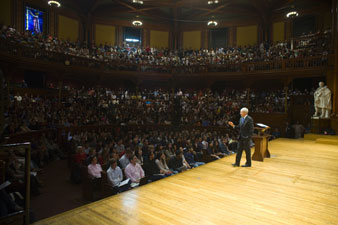
Every fall they pack Sanders Theatre to the rafters. A spellbinding philosopher takes the stage before a rapt crowd of Harvard students, and soon enough the cavernous space becomes a classroom where the bright shades of Aristotle, Jeremy Bentham, Immanuel Kant and John Rawls are summoned to have their say on the enduring questions. What is the good life? Is pleasure the highest end, or is something else? Are acts moral because they lead to good consequences, or because they are done on principle? To keep the discussion grounded, the class--called simply "Justice," it now regularly enrolls more than 1,000 undergraduates--is asked to confront these quandaries in the context of hard cases brought to life by the philosopher's trademark hypothetical situations or policy dilemmas culled from newspaper articles.
Read on...
This is a nice read for a Sunday morning. Tom
Subscribe to:
Posts (Atom)