Moneyballing Justice: "Evidence-Based" Criminal Reforms Ignore Real Evidence
"Proponents of the new wave of 'criminal justice reform' claim that
their efforts are nonpartisan, non-ideological and 'evidence-based.'
This 'evidence-based' frame asserts that mass incarceration and 'overcriminalization' will be remedied by a handful of sentencing
reforms affecting 'low-level' offenders. An essential element of such
reform is the widespread use of 'evidence-based risk-assessment'
instruments to purportedly help authorities objectively determine who is 'dangerous' - and therefore must remain in prison - and who is not.
This isn't a miracle cure; it is a lavishly funded public relations
campaign advancing unfettered free-market 'solutions' to criminal
justice dilemmas and the politics of austerity. 'Bipartisanship' is driven by a right-wing agenda
and support from a constellation of libertarian and neoliberal economic
interests. It is funded by Koch Industries and a handful of foundations
and deep-pocketed donors. Yes, some high-profile people and groups
considered liberal have signed on - but to messaging and strategic
direction already established by the right."

Your resource for news, research, opinion and comment in the world of Criminology and Criminal Justice, brought to you by the Criminology Library, Centre for Criminology & Sociolegal Studies, University of Toronto
Showing posts with label privatization. Show all posts
Showing posts with label privatization. Show all posts
Probation Officers Face Redundancy in Plan to Replace them with Machines
"The largest UK private probation operator plans to allow offenders to report in at ATM-style electronic kiosks as part of cost-cutting plans that will involve large-scale redundancies.
Sodexo justice services, which runs six of the 21 newly privatised community rehabilitation companies (CRCs) in England and Wales, intends to introduce the kiosks so offenders can report in without having to see a probation officer.
The company’s 'new operating model' makes clear it intends to introduce 'biometric reporting' using cash machine-style kiosks.
The machines, which use fingerprint recognition technology to check identities, allow an offender to report in, to give and receive information, and to request a face-to-face meeting with a probation officer. Offenders are to be allowed to report into probation using the kiosks as a reward for good compliance with the early stages of their supervision order or prison release licence.
The company also plans to set up one centralised administrative hub supporting operational staff in face-to-face contact with offenders. The probation union Napo says this will mean some low-risk offenders being supervised via a call centre despite the majority of serious further offences being committed by offenders categorised as low-to-medium risk."
"The largest UK private probation operator plans to allow offenders to report in at ATM-style electronic kiosks as part of cost-cutting plans that will involve large-scale redundancies.
Sodexo justice services, which runs six of the 21 newly privatised community rehabilitation companies (CRCs) in England and Wales, intends to introduce the kiosks so offenders can report in without having to see a probation officer.
The company’s 'new operating model' makes clear it intends to introduce 'biometric reporting' using cash machine-style kiosks.
The machines, which use fingerprint recognition technology to check identities, allow an offender to report in, to give and receive information, and to request a face-to-face meeting with a probation officer. Offenders are to be allowed to report into probation using the kiosks as a reward for good compliance with the early stages of their supervision order or prison release licence.
The company also plans to set up one centralised administrative hub supporting operational staff in face-to-face contact with offenders. The probation union Napo says this will mean some low-risk offenders being supervised via a call centre despite the majority of serious further offences being committed by offenders categorised as low-to-medium risk."
6 Reasons Privatization Often Ends in Disaster
Private systems are focused on making profits for a few
well-positioned people. Public systems, when sufficiently supported by
taxes, work for everyone in a generally equitable manner.
The following are six specific reasons why privatization simply doesn't work.
The Profit Motive Moves Most of the Money to the Top
The federal Medicare Administrator made $170,000 in 2010. The president of MD Anderson Cancer Center in Texas made over ten times as much in 2012. Stephen J. Hemsley, the CEO of United Health Group, made almost 300 timesas much in one year, $48 million, most of it from company stock.
In part because of such inequities in compensation, our private health care system is the most expensive system in the developed world. The price of common surgeries is anywhere from three to ten times higher in the U.S. than in Great Britain, Canada, France, or Germany. Two of the documented examples: an $8,000 special stress test for which Medicare would have paid $554; and a $60,000 gall bladder operation, for which a private insurance company was willing to pay $2,000.
Read on...
The following are six specific reasons why privatization simply doesn't work.
The Profit Motive Moves Most of the Money to the Top
The federal Medicare Administrator made $170,000 in 2010. The president of MD Anderson Cancer Center in Texas made over ten times as much in 2012. Stephen J. Hemsley, the CEO of United Health Group, made almost 300 timesas much in one year, $48 million, most of it from company stock.
In part because of such inequities in compensation, our private health care system is the most expensive system in the developed world. The price of common surgeries is anywhere from three to ten times higher in the U.S. than in Great Britain, Canada, France, or Germany. Two of the documented examples: an $8,000 special stress test for which Medicare would have paid $554; and a $60,000 gall bladder operation, for which a private insurance company was willing to pay $2,000.
Read on...
Revealed: government plans for police privatisation
West Midlands and Surrey police offer £1.5bn contract under which private firms may investigate crime and detain suspects
Private companies could take responsibility for investigating crimes, patrolling neighbourhoods and even detaining suspects under a radical privatisation plan being put forward by two of the largest police forces in the country.
West Midlands and Surrey have invited bids from G4S and other major security companies on behalf of all forces across England and Wales to take over the delivery of a wide range of services previously carried out by the police.
The contract is the largest on police privatisation so far, with a potential value of £1.5bn over seven years, rising to a possible £3.5bn depending on how many other forces get involved.
This doesn't sound like a great idea. Tom
Private Prisons Gone Wild
Legal challenges are no match for Arizona politicians determined to privatize the state’s correctional services.
The recent dismissal of a lawsuit filed against both Arizona Department of Corrections (ADC) Director Charles Ryan and Arizona Governor Jan Brewer (R) is the latest step in the state’s hell-bent plan to roughly double its number of privately managed prison “beds.”
The suit, filed in an Arizona Superior Court by the American Friends Service Committee (AFSC) on September 12, sought an injunction against ADC and the governor’s pending award of 5,000 new prison beds to be operated by a for-profit vendor. The state currently contracts out more than 6,500 minimum- and medium-security beds at seven facilities with Geo Group, the nation’s second largest private prison operator, and Management and Training Corporation (MTC).
AFSC argued that ADC is negligent in its statutorily required duty to conduct biennial cost and quality assessments of the state’s private prisons. The purpose of these assessments is to determine whether the state is receiving the same quality of service from private prison operators as provided by public facilities.
Nevertheless, ADC has not completed a single survey.
Chomsky: Public Education Under Massive Corporate Assault — What's Next?
Converting schools and universities into facilities that produce commodities for the job market, privatizing them, slashing their budgets — do we really want this future?
The following is a partial transcript of a recent speech delivered by Noam Chomsky at the University of Toronto at Scarborough on the rapid privatization process of public higher education in the United States.

The following is a partial transcript of a recent speech delivered by Noam Chomsky at the University of Toronto at Scarborough on the rapid privatization process of public higher education in the United States.
A couple of months ago, I went to Mexico to give talks at the National University in Mexico, UNAM. It's quite an impressive university — hundreds of thousands of students, high-quality and engaged students, excellent faculty. It's free. And the city — Mexico City — actually, the government ten years ago did try to add a little tuition, but there was a national student strike, and the government backed off. And, in fact, there's still an administrative building on campus that is still occupied by students and used as a center for activism throughout the city. There's also, in the city itself, another university, which is not only free but has open admissions. It has compensatory options for those who need them. I was there, too; it's also quite an impressive level, students, faculty, and so on. That's Mexico, a poor country.
Right after that I happened to go to California, maybe the richest place in the world. I was giving talks at the universities there. In California, the main universities — Berkeley and UCLA — they're essentially Ivy League private universities — colossal tuition, tens of thousands of dollars, huge endowment. General assumption is they are pretty soon going to be privatized, and the rest of the system will be, which was a very good system — best public system in the world — that's probably going to be reduced to technical training or something like that. The privatization, of course, means privatization for the rich [and a] lower level of mostly technical training for the rest. And that is happening across the country. Next year, for the first time ever, the California system, which was a really great system, best anywhere, is getting more funding from tuition than from the state of California. And that is happening across the country. In most states, tuition covers more than half of the college budget. It's also most of the public research universities. Pretty soon only the community colleges — you know, the lowest level of the system — will be state-financed in any serious sense. And even they're under attack. And analysts generally agree, I'm quoting, "The era of affordable four-year public universities heavily subsidized by the state may be over."
Key probation services to be put out to tender
Core work, including supervising offenders and writing pre-sentence reports, to be taken out of the public sector
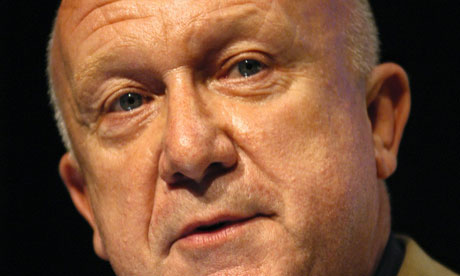 Harry Fletcher, of Napo, predicted the quality of work would be reduced if core probation services were put out to competition.
Harry Fletcher, of Napo, predicted the quality of work would be reduced if core probation services were put out to competition.Core probation services, including the supervision of criminals, are to be put out to competition, in the most arresting example yet of the impact of the "big society" drive on the criminal justice system.
The 35 chief officers of probation have been told they need to examine the "potential for core probation services" to be put up for competition.
Michael Spurr, the chief executive of the National Offender Management Service, has written to chief probation officers telling them: "We intend to examine a range of possible options for service improvements and different models of delivering offender services within the community.
"The aim is to create a long-term direction for probation which is consistent with the government's key objective for reform."
Has America Become a Corporate Police State?
In just the last few years, the Corporate Police State has reared its head at every level of government.

Corporate Police State," it's a fraught -- some might even say, overwrought -- term. But in its purest, apolitical form, it simply describes the periodic commingling of state and corporate power to protect private interests.
Corporate Police State," it's a fraught -- some might even say, overwrought -- term. But in its purest, apolitical form, it simply describes the periodic commingling of state and corporate power to protect private interests.
In the American psyche, any discussion of that phenomenon typically brings one of three images to mind. There's the Old Corporate Police State -- the sepia-toned America of decades long past, a place where state militias murder striking mine workers on behalf of Gilded Age barons and Congress empowers the government to forcibly ban work stoppages that defy corporate executives' wishes. There's the Fictional Future Corporate Police State -- that smoldering bombed-out world depicted in "Robocop," "Fortress" and every other dystopian flick in Hollywood's post-apocalyptic catalog. And there's the Foreign Corporate Police State -- think Dubai, Singapore, Monaco and every other lavish enclave defined by lots of rich people, lots of corporate headquarters, lots of heavily armed cops -- and almost no civil liberties.
How frickin' typical. Rotten right-wing idea—prisons for profit—costs more
Privatization, whether of public transportation or public libraries, always comes with costs that the privatizers deny when they're lobbying to get the deed done. You know, little things like fewer routes and reduced schedules and smaller, lower-paid staffs accompanied by higher fares and fees. No surprise that the politicians in the pocket of the privatizers go along. But others, who should know better, frequently succumb as well to the siren call of we-can-take-this-expensive-burden-off-your-hands-and-it-will-end-your-budget-problems-forever. And then comes the screw job.
Nowhere except in the military is privatization a worse idea than in prisons. Abuse is rife and inhumane conditions, including overcrowding, are common. So are escapes. The corporations that build private prisons suck up development subsidies. And they go after small towns desperate for jobs.
Subscribe to:
Posts (Atom)