Positive Outcomes: Strategies for Assessing the Progress of Youth Involved in the Justice System
"Across the United States, youth justice systems are increasingly
turning to the science of adolescent development to inform their
intervention approaches and to measure youth success. Scientific
knowledge about adolescent development is often expressed through the
principles of positive youth development (PYD), a programmatic framework
that encourages service providers to concentrate on the ability of all
young people to thrive when they experience positive relationships and
meaningful activities in supportive and safe environments.
Some youth service systems have long relied on PYD principles—e.g.,
out-of-school-time programs. Youth justice, however, began to embrace
the PYD approach only recently. Interventions based on PYD principles
are not a natural fit for youth justice systems that focus on
controlling misbehavior and preventing subsequent contacts with justice
authorities (i.e. recidivism).
Measuring positive outcomes in youth justice requires a shift away
from recidivism as the sole indicator of program effectiveness. A youth
justice system embracing the PYD approach would gauge its success by
tracking positive youth outcomes, such as the formation of strong and
supportive relationships, academic engagement, labor market readiness,
and improved socio-emotional skills. These outcomes encourage a broader
perspective on the goals of justice intervention and pursuing these
goals would transform youth justice systems, making them more consistent
with research on adolescent development, strengths-based perspectives,
and community connections for youth."

Your resource for news, research, opinion and comment in the world of Criminology and Criminal Justice, brought to you by the Criminology Library, Centre for Criminology & Sociolegal Studies, University of Toronto
Showing posts with label youth justice. Show all posts
Showing posts with label youth justice. Show all posts
Youth, Safety, and Violence: Schools, Communities, and Mental Health
This policy brief contributes to the urgent national conversation about
violence against children, and provides three perspectives from Vera
experts on school safety, mental illness, and the delivery of mental
health services. The perspectives draw on Vera’s work with government
partners in each of these areas to develop and implement ways of
enhancing the safety, effectiveness, and fairness of systems. They offer
recommendations on placing police in schools, considering mental health
care as a public health issue, and providing mental health care service
providers with the knowledge needed to prevent violence. Vera released
the brief at a Congressional staff briefing in Washington, DC on
February 12, 2013.
Read on...
Read on...
UN rights group says federal justice reforms ‘excessively punitive’ on youth
The federal government’s tough-on-crime agenda is “excessively
punitive” for youth and is a step backwards for Canada’s child rights
record, says a United Nations group.
The UN committee on the rights of the child has finished a 10-year review of how Canada treats its children and how well governments are implementing the Convention on the Rights of the Child.
In particular, the committee says Canada’s Youth Criminal Justice Act complied with international standards until changes were introduced earlier this year.
The Harper government’s Bill C-10 – an omnibus crime bill that includes stiffer penalties for youth and makes it easier to try them as adults – no longer conforms to the child rights convention or other international standards.
Bill C-10 “is excessively punitive for children and not sufficiently restorative in nature,” the committee wrote in a report published over the weekend.
Read on...
Legislative Victories from 2005 to 2010. Removing Youth from the Adult Criminal Justice System
Stemming from one family’s individual case,
we launched the Campaign for Youth Justice
(CFYJ) five years ago to respond to a crisis throughout
the country: an estimated 250,000 youth under
18 are prosecuted in the adult criminal justice system
every year.
A spike in youth crime during the 1980s and 1990s
prompted state policymakers to expand laws to put
more children in adult court, implement mandatory
sentencing policies for certain crimes, and lower
the age at which a child could be prosecuted as
an adult. State policymakers
believed their efforts would
improve public safety and
deter future crime. However,
studies across the nation have
consistently concluded that
state laws prosecuting youth
in adult court are ineffective
at deterring crime and reducing
recidivism.
Four years ago we issued
our first national report, The
Consequences Aren’t Minor,
documenting the multiple
unintended consequences of
these laws. With the help of the National Council
on Crime and Delinquency and the Justice Policy
Institute, we analyzed all of the available research
and conducted interviews with dozens of incarcerated
youth in adult jails and prisons in states all
over the country.
We found that youth tried as adults face the same
punishments as adults. They can be placed in adult
jails pre- and post-trial, sentenced to serve time in
adult prisons, or be placed on adult probation with
few to no rehabilitative services. Youth also are
subject to the same sentencing guidelines as adults
and may receive mandatory minimum sentences including
life without parole. The only consequence
that youth cannot receive is the death penalty.
Read on...
This report is from the Campaign for Youth Justice. Tom
Public sector cuts: Rise in youth crime feared as key teams are reduced
Ministers told that councils will find it 'exceptionally difficult to maintain a basic youth offending team'
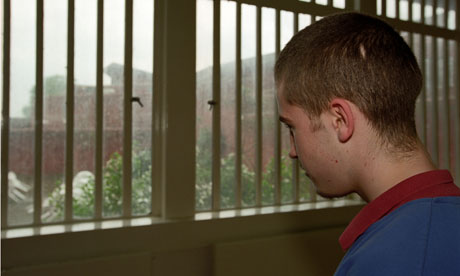 A teenager in a young offenders institution: a rise in youth crime is feared because of cuts to youth offending teams. Photograph: Mark
A crime prevention project in Cornwall that has helped more than 960 young people since it started in 2003 is to close at the end of this month because its £185,000 funding from a government local area agreement is to end. The project, White Gold, a partnership between the police and Cornwall youth offending team (YOT), is an early casualty of funding cuts.
Nationally, ministers have been warned that funding reductions will mean that some of the 157 local authorities across England and Wales will find it "exceptionally difficult to maintain a basic youth offending team". Sandwell council in the West Midlands has placed the entire 80-strong YOT staff on its "at risk of redundancy register", as cuts of up to 30% in youth justice funding start to bite across England and Wales.
The national network of YOTs was set up to bring together the work of the police, probation, social services, education and others in tackling youth offending, with significant results in cutting crime, which council leaders now fear will rise.
Nicholas Freudenberg: What works to keep young men from returning to jail?
From the Vera Institute of Justice
“ECONOMIC APSECTS OF THE DEVELOPMENT AND PREVENTION OF CRIMINALITY AMONG CHILDREN AND YOUTH A Sequel to the Kids ‘N Crime Report”
In this (follow-up) report Kids 'N Crime: Economic Aspects of the Development and Prevention of Criminality among Children and Youth, , released in September 2010, “…twelve different facets of the development and prevention of criminality among children are reviewed.
This is from the Justice Institute of British Columbia - Tom
This is from the Justice Institute of British Columbia - Tom
A Powerful Idea on Youth Violence
As a former beat cop, Ron Huberman, the new chief of public schools in Chicago, learned long ago that violence among young urban people could not be solved simply by hauling ever larger numbers of children off to jail.
With the prompting and support of his boss, Mayor Richard M. Daley, Mr. Huberman is trying a new approach to the violence that has killed and maimed hundreds of young people and turned Chicago’s poorest neighborhoods into precincts of terror and despair.
The ambitious plan will offer mentoring, counseling and jobs to high-risk students. To determine who they are, Mr. Huberman analyzed the cases of more than 500 young people who were killed or wounded in gun violence over the last two years. The analysis suggests that nearly 10,000 of the city’s 113,000 high school students are at risk of becoming victims of gun violence and need help.Read on...
A New York Times editorial. Tom
New Report Highlights Reforms in Status Offender Systems
When Vera staff began working to reform status offender systems almost a decade ago, chronically misbehaving youth were routinely referred to juvenile court and subject to the same punitive interventions as youth charged with criminal activity. Experience has shown that such interventions are costly and often exacerbate existing family challenges. Today, as jurisdictions evaluate and refine their status offender systems, a new paradigm is emerging that aims to provide immediate, individualized services to youth and their families outside of the juvenile court system. Making Court the Last Resort: A New Focus for Supporting Families in Crisis [pdf], a new report from Vera’s Center on Youth Justice, describes this new paradigm by highlighting successful status offender system reforms in Florida, New York, and Connecticut. |
The Vera Institute of Justice is an independent, nonprofit organization that combines expertise in research, demonstration projects, and technical assistance to help leaders in government and civil society improve the systems people rely on for justice and safety. |
To learn more about the Vera Institute of Justice, visit www.vera.org. |
roots of youth violence - report
The McMurtry/Curling report: rootsofyouthviolence is available online. The Criminology Library is obtaining a hardcopy of the report.
Report seeks $100-million for youth programs
Created after death of Jordan Manners, provincial review ends with requests for spending, creation of a youth commissioner, more central role for schools in community
TIMOTHY APPLEBY
From Friday's Globe and Mail
November 14, 2008 at 4:19 AM EST
Creation of a special youth commissioner, an enhanced role for schools and a $100-million allocation of funds will head the recommendations of a long-awaited provincial report on youth violence to be released today.
"This will mark a framework for the future of young people in this province," said a source familiar with the report by former Ontario chief justice Roy McMurtry and former Liberal MPP Alvin Curling.
Read on...
PM's plan: Life terms for 14-year-olds
Les Whittington Ottawa Bureau
DRYDEN, Ont.–Prime Minister Stephen Harper has played the law-and-order card, seeking to tap into Canadians' fear of gang violence and street crime by proposing a crackdown on youth offenders.
Under his proposed law-and-order legislation, judges would have the option to sentence youths 14 and older to life in prison if they are convicted of first-degree or second-degree murder, Harper said yesterday.He also said he would legislate tougher sentences for other violent youth crime, such as attempted murder, manslaughter and aggravated assault. And Harper would change the law to ensure that names of those convicted would be made public.
Can someone tell me precisely who this will appeal to? Who has been advocating sentencing 14 year olds to life in prison? Please don't tell me polling indicates this is a winning issue in Canada. Tom
Subscribe to:
Posts (Atom)