Link to Complete Article
"This article answers a question that has confounded the lower federal
courts: whether a suspect briefly detained under the doctrine of Terry
v. Ohio is obligated to answer police questions posed to her. Although
the Supreme Court has never explicitly found a right to remain silent
during a Terry stop, it has, through dicta, concurrences, and elsewhere,
consistently assumed the existence of such a right. Nonetheless, more
than fifty years after Terry was decided, lower federal courts
consistently deny recovery to those who allege they were wrongfully
arrested for refusing to answer police questions. Interestingly, these
courts rarely reject outright the existence of a right to silence in the
Terry context. Rather, they simply find that because such a right is
not clearly established, officers who arrest suspects for refusing to
answer their questions are entitled to qualified immunity."

Your resource for news, research, opinion and comment in the world of Criminology and Criminal Justice, brought to you by the Criminology Library, Centre for Criminology & Sociolegal Studies, University of Toronto
Showing posts with label stop and frisk. Show all posts
Showing posts with label stop and frisk. Show all posts
Does Stop and Search Reduce Crime?
"Despite recent declines in its use, stop and search continues to be one of the most controversial powers vested in police in England and Wales. Yet until recently there has been surprisingly little research assessing its effectiveness in reducing crime. In this briefing we attempt to redress this imbalance. Starting with an overview of recent trends in the use of stop and search, we then draw on our own research, as well as a number of other recently published studies, to suggest that its overall effect on crime is likely to be at best marginal. Existing research evidence seems to converge on this conclusion. This, we suggest, means that questions of the effectiveness of stop and search cannot be considered independently of the wider issues that surround the power: social and cultural understandings of what police are for; and a clear-eyed view of the impact policing has for those individuals and communities subject to it."
Read on...
Read on...
The Real Costs of Policing the Police
SETTING aside the legal wisdom of the recent decision by a federal judge against the New York Police Department and its stop-and-frisk
policy, one thing seems clear: the judge’s remedy will be enormously
expensive and time-consuming to implement, and at a time when the number of stops is falling dramatically.
No one, of course, should be stopped by a police officer on the basis of skin color or ethnic origin. The judge, Shira A. Scheindlin
of Federal District Court in Manhattan, found that the benefits of
ending what she considers to be unconstitutional stops would far
outweigh any administrative hardships.
Still, the reforms she has laid out are sweeping in their impact on the
department and its 35,000 officers, who have been excoriated and
vilified in the months leading up to the trial and in the aftermath of
the ruling.
The city has filed a notice of appeal, and Mayor Michael R. Bloomberg
said he hopes the appeal process would allow current stop-and-frisk
practices to continue. But Mr. Bloomberg, an independent, leaves office
at the end of the year. The Democratic candidates vying to succeed him
have vowed to scale back, or even halt, the practice.
5 Reasons Why This Week Was Historic for Ending America's War on Drugs and Cruel Incarceration Policies
Stop-and-frisk is ruled unconstitutional and Sanjay Gupta changes his opinion about marijuana on national TV.
It happened at a dizzying pace. One big victory for the drug and prison reform community after another. The Attorney General addressed our massive prison problem, the DEA continues to be scrutinized for its shady law enforcement tactics, a federal judge ruled the NYPD's stop-and-frisk tactic unconstitutional, a major media personality admitted he was wrong about marijuana's health risks, and New York City's Comptroller released a report explaining why marijuana should be legalized.
All of this is great news for advocates of sensible drug policy, civil rights, privacy rights, and prison reform.
1. Eric Holder Gets "Smarter On Crime"
On Monday, US Attorney General Eric Holder gave a speech at the American Bar Association's annual meeting in which he announced a major shift in criminal justice policy aimed at addressing unfairness in the justice system. Although the US has only 5 percent of the world's population, it has 25 percent of its prisoners. Almost half of federal inmates are serving time on drug charges. "The war on drugs is now 30, 40 years old," Holder told NPR earlier this month. "There has been a lot of unintended consequences. There's been a decimation of certain communities, in particular communities of color."
Read on...
It happened at a dizzying pace. One big victory for the drug and prison reform community after another. The Attorney General addressed our massive prison problem, the DEA continues to be scrutinized for its shady law enforcement tactics, a federal judge ruled the NYPD's stop-and-frisk tactic unconstitutional, a major media personality admitted he was wrong about marijuana's health risks, and New York City's Comptroller released a report explaining why marijuana should be legalized.
All of this is great news for advocates of sensible drug policy, civil rights, privacy rights, and prison reform.
1. Eric Holder Gets "Smarter On Crime"
On Monday, US Attorney General Eric Holder gave a speech at the American Bar Association's annual meeting in which he announced a major shift in criminal justice policy aimed at addressing unfairness in the justice system. Although the US has only 5 percent of the world's population, it has 25 percent of its prisoners. Almost half of federal inmates are serving time on drug charges. "The war on drugs is now 30, 40 years old," Holder told NPR earlier this month. "There has been a lot of unintended consequences. There's been a decimation of certain communities, in particular communities of color."
Read on...
On policing, New York should look to L.A.
Now that a federal court has ruled against its 'stop and frisk' policies, NYPD would be wise to learn from a reformed LAPD.
New York Mayor Michael R. Bloomberg on Monday insisted that his city's "stop and frisk" police practices were constitutional, despite a federal judge's finding that they were racially discriminatory and violated the 4th and 14th Amendments. But it's almost beside the point whether Bloomberg is on solid legal ground and whether his appeal can succeed. New York's confrontational approach to law enforcement has bought short-term results at the cost of alienation and resentment, and its leaders would be wise to let the trial court's ruling stand — and to learn a lesson from Los Angeles.For decades, this city mastered the dark art of enforcement by intimidation. The Los Angeles Police Department cultivated an us-versus-them relationship with African American and other nonwhite neighborhoods and employed brutal tactics that, even when legally defensible, were destructive to the city. The daily affronts to residents' dignity, the car stops, the searches, the killer chokeholds, the sweeps and roundups, and the unequal and unjust treatment from officers stoked anger that resulted in violent outbursts in 1965 and 1992, and still couldn't keep gangs from growing or crime from bleeding into the white, well-to-do and formerly comfortable and confident areas of the city.
Read on...
A Verdict on Racial Profiling?
A judge has ruled stop-and-frisk unconstitutional and racist. But will it stop?
A federal judge‘s ruling has finally affirmed what activists in New York City have been saying for years: The New York City Police Department (NYPD) policy of “stop-and-frisk” is legalized racial profiling and harassment. The long-awaited decision came in response to a lawsuit by eight plaintiffs challenging the constitutionality of stop-and-frisk. But more fundamentally, it was the product of an activist movement that has for years highlighted the racist implications of this policy. The longstanding campaign to stop “stop-and-frisk” gained new momentum in the aftermath of high profile cases of police brutality and murder.
In February of 2012, unarmed African American teenager Ramarley Graham was gunned down in his bathroom by NYPD officers claiming they saw a gun in the waistband of his pants. This case helped to mobilize thousands of New Yorkers to take to the streets more than a year ago to oppose the policy. The murder of Trayvon Martin just days after Ramarley's death sparked a national discussion about the perils of racial profiling and the impact on young African-American men. All of this contributed to an atmosphere where stop-and-frisk could no longer go unchallenged.
According to a report by the Center for Constitutional Rights, between 2004 and 2012, more than 4 million people were stopped, and in less than 6 percent of those stops was an arrest made. More than 80 percent of those 4 million people were African American or Latino, raising the cry from those communities that stop-and-frisk was officially sanctioned racial profiling.
Read on...
A federal judge‘s ruling has finally affirmed what activists in New York City have been saying for years: The New York City Police Department (NYPD) policy of “stop-and-frisk” is legalized racial profiling and harassment. The long-awaited decision came in response to a lawsuit by eight plaintiffs challenging the constitutionality of stop-and-frisk. But more fundamentally, it was the product of an activist movement that has for years highlighted the racist implications of this policy. The longstanding campaign to stop “stop-and-frisk” gained new momentum in the aftermath of high profile cases of police brutality and murder.
In February of 2012, unarmed African American teenager Ramarley Graham was gunned down in his bathroom by NYPD officers claiming they saw a gun in the waistband of his pants. This case helped to mobilize thousands of New Yorkers to take to the streets more than a year ago to oppose the policy. The murder of Trayvon Martin just days after Ramarley's death sparked a national discussion about the perils of racial profiling and the impact on young African-American men. All of this contributed to an atmosphere where stop-and-frisk could no longer go unchallenged.
According to a report by the Center for Constitutional Rights, between 2004 and 2012, more than 4 million people were stopped, and in less than 6 percent of those stops was an arrest made. More than 80 percent of those 4 million people were African American or Latino, raising the cry from those communities that stop-and-frisk was officially sanctioned racial profiling.
Read on...
NYPD commissioner Ray Kelly 'wanted to instil fear' in black and Latino men
At stop-and-frisk trial, New York state senator and former police
captain Eric Adams testifies about 2010 conversation with Kelly
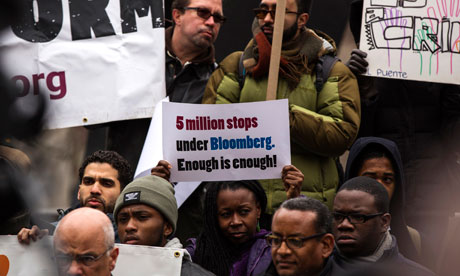
Demonstrators protest
the NYPD's stop-and-frisk police outside of Manhattan federal court last
month. Photograph: Lucas Jackson/Reuters
The commissioner of the New York
City police department views the controversial practice of stop,
question and frisk as a means to instil fear in young African American
and Latino men, a New York state senator testified in a federal court on
Monday.
State senator Eric Adams, who retired from the NYPD after rising to the rank of captain during a 22-year career, said commissioner Ray Kelly described his views on stop and frisk during a July 2010 meeting in the office of then-governor David Patterson.
Adams had traveled to Albany for a meeting on 10 July 2010 with the governor to give his support for a bill that would prohibit the NYPD from maintaining a database that would include the personal information of individuals stopped by the police but released without a charge or summons. In discussing the bill, which ultimately passed, Adams said he raised the issue of police stops disproportionately targeting young African American and Latino men.
Read on...
State senator Eric Adams, who retired from the NYPD after rising to the rank of captain during a 22-year career, said commissioner Ray Kelly described his views on stop and frisk during a July 2010 meeting in the office of then-governor David Patterson.
Adams had traveled to Albany for a meeting on 10 July 2010 with the governor to give his support for a bill that would prohibit the NYPD from maintaining a database that would include the personal information of individuals stopped by the police but released without a charge or summons. In discussing the bill, which ultimately passed, Adams said he raised the issue of police stops disproportionately targeting young African American and Latino men.
Read on...
NYPD on Trial: Police Say They Are Forced to Harass Kids in Order to Meet Quotas
Last week, NYPD whistleblowers Adhyl Polanco and Pedro Serrano, who
secretly recorded supervisors demanding that officers fill quotas,
testified in federal court that they were forced to violate the law to
meet numbers. “We were handcuffing kids for no reason,” Polanco
testified. The two officers are testifying in a class-action suit
targeting the NYPD's stop-and-frisk policy.
Quotas for NYPD activity are illegal under New York labor
law, but secretly recorded roll calls reveal supervisors pushing
officers to get "20-and 1," meaning 20 summonses and 1 arrest per month.
Monthly quotas also required five "250s," or street stops.
“There’s a difference between” the department’s policies on
paper and “what goes on out there,” in real life, Polanco told the
court.
A Damning Look Inside NYPD’s ‘Stop-and-Frisk’ Policy
Stop-and-frisk is already considered a
controversial tactic employed by the New York Police Department, but a
recently released recording sheds light on just how discriminatory the
practice can actually be. The audio was secretly taped by a teenager who
was stopped and frisked (and more) by NYPD officers. In it, 17-year-old
Alvin is heard being roughed up, threatened and demeaned by three
officers, for being, as one put it, “a fucking mutt.”
Here’s some background on the controversial stop-and-frisk policy from Gawker:
Read on...
Here’s some background on the controversial stop-and-frisk policy from Gawker:
Though the tactic, which finds police arbitrarily seizing citizens and forcing them to empty their pockets and bags, has faced legal challenges more than once, and while its use is on the decline, it continues to be a go-to way for police to patrol predominantly minority areas. Of the nearly 700,000 stop-and-frisks performed in 2011, 84 percent were conducted on blacks and Latinos, and only 2 percent turned up contraband, according to the Center for Constitutional Rights.
Essentially, what stop-and-frisk has become is a legal way for police officers to harass and demean young male minorities, the vast majority of whom turn out to be totally innocent.
Read on...
Stop-and-Frisks Fail to Pull More Guns Off the Street, NYPD Stats Show
The number of guns taken off the street by the NYPD has dropped during the Bloomberg era despite a 600 percent increase in stop-and-frisks, DNAinfo.com New York has found.
During the past two years alone, the number of firearms seized by police has fallen 13.5 percent from 3,908 in 2009 with 510,742 frisks, to 3,443 last year, when the NYPD stopped and frisked a record-busting 685,724 New Yorkers.
And last week the NYPD reported that during the first half of this year, firearm seizures continues to fall to 1,613, compared to 1,705 during the first six months of last year. The downturn came as the NYPD conducted 337,434 stops-and-frisks — a figure that keeps the NYPD on pace to match last year’s record-busting total.
By comparison, during Bloomberg’s first year in office in 2002, the NYPD recovered 4,069 guns — but the police stop-and-frisked only 96,000 people that year, according to NYPD data.
During the past two years alone, the number of firearms seized by police has fallen 13.5 percent from 3,908 in 2009 with 510,742 frisks, to 3,443 last year, when the NYPD stopped and frisked a record-busting 685,724 New Yorkers.
And last week the NYPD reported that during the first half of this year, firearm seizures continues to fall to 1,613, compared to 1,705 during the first six months of last year. The downturn came as the NYPD conducted 337,434 stops-and-frisks — a figure that keeps the NYPD on pace to match last year’s record-busting total.
By comparison, during Bloomberg’s first year in office in 2002, the NYPD recovered 4,069 guns — but the police stop-and-frisked only 96,000 people that year, according to NYPD data.
NYPD Posts ‘Wanted’ Flyer Targeting Couple That Legally Videotapes Stop-And-Frisks
The New York Police Department has put out a “police advisory” flyer
warning cops and residents to look out for two “professional agitators,”
a Harlem couple who film officers stopping and frisking young New Yorkers of color.
DNAinfo reports that Matthew Swaye, 35, and his partner Christina Gonzalez, 25, came across the poster, complete with mugshots and the official seal of the NYPD’s intelligence division, taped to a podium in the 30th precinct’s public hearing room while attending a precinct council meeting. The flyer listed the home address of the couple and warned:
DNAinfo reports that Matthew Swaye, 35, and his partner Christina Gonzalez, 25, came across the poster, complete with mugshots and the official seal of the NYPD’s intelligence division, taped to a podium in the 30th precinct’s public hearing room while attending a precinct council meeting. The flyer listed the home address of the couple and warned:
Be aware that the subjects are known professional agitators that live at [home address]. Above subjects mo is that they video tape officers performing routine stops and post on youtube. Subjects purpose is to portray officers in a negative way and too deter officers from conducting there responsibilities. Above subjects also deter officers from being safe and tactical by causing unnecessary distractions. Do not feed into subjects propaganda.Read on...
Huge Multiracial Father's Day March Tells Bloomberg and NYPD, 'No More Stop-and-Frisk!'
Momentum has been building in the movement to end stop-and-frisk, but many were still amazed at the size of the crowd Sunday
A Father’s Day crowd that some estimated to be as large as 50,000 marched in silent protest on Sunday afternoon in NYC, letting Mayor Michael Bloomberg and Police Commissioner Ray Kelly know, in no uncertain terms, that they've had enough of the NYPD's policy of stop-and-frisk, a racial profiling tactic that has resulted in the illegal arrests of tens of thousands of young black and Latino men.
While the movement to end stop-and-frisk has been growing, many were amazed at the size of the crowd Sunday. The march included the National Association for the Advancement of Colored People (NAACP), the 1199 Service Employees International Union, and the National Action Network, as well as community organizing from groups like VOCAL-NY, the grassroots stop-and-frisk coalition and LGBT-rights groups. Organizer Leslie Cagan told AlterNet that more than 300 groups endorsed the march. The outpouring of solidarity, she said, shows that, “The people are ready, and the time has come.”
Read on...
A Father’s Day crowd that some estimated to be as large as 50,000 marched in silent protest on Sunday afternoon in NYC, letting Mayor Michael Bloomberg and Police Commissioner Ray Kelly know, in no uncertain terms, that they've had enough of the NYPD's policy of stop-and-frisk, a racial profiling tactic that has resulted in the illegal arrests of tens of thousands of young black and Latino men.
While the movement to end stop-and-frisk has been growing, many were amazed at the size of the crowd Sunday. The march included the National Association for the Advancement of Colored People (NAACP), the 1199 Service Employees International Union, and the National Action Network, as well as community organizing from groups like VOCAL-NY, the grassroots stop-and-frisk coalition and LGBT-rights groups. Organizer Leslie Cagan told AlterNet that more than 300 groups endorsed the march. The outpouring of solidarity, she said, shows that, “The people are ready, and the time has come.”
Read on...
Policing by the Numbers
THE pervasive use of stop-and-frisk
tactics that have deeply alienated racial and ethnic minorities in New
York City is only one symptom of a broader dysfunction in the Police
Department.
The overwhelming pressure on officers to write summonses, make arrests, stop pedestrians and motorists with little or no justification, and downgrade crime reports reflects the deterioration of effective management under Raymond W. Kelly, the longest-serving police commissioner in the city’s history.
Read on....
This is a New York Times editorial. Tom
The overwhelming pressure on officers to write summonses, make arrests, stop pedestrians and motorists with little or no justification, and downgrade crime reports reflects the deterioration of effective management under Raymond W. Kelly, the longest-serving police commissioner in the city’s history.
Read on....
This is a New York Times editorial. Tom
Tale of Two Cities: NYPD's Racist Arrests Create Class War in New York
For the NYPD's stats to add up, they'd have to have stopped every young, black man living in the city once--and then some.
This Saturday, May 12, in New York City, an alliance of more than 100 community activists, mothers, city councilmembers and religious leaders marched from Foley Square to One Police Plaza, demanding an end to police tactics they say have resulted in two New Yorks -- or as the action was appropriately titled, “A Tale of Two Cities.
-New York, Law Enforcement Against Prohibition (LEAP), the Drug Policy Alliance, and other groups organized the event to demand an end to the racial segregation they say Mayor Michael Bloomberg and Police Commissioner Ray Kelly actively enforce. The demonstration hinged tightly on the power of a united New York. Nine white New Yorkers attempted civil disobedience at the police headquarters, but were (ironically) not arrested.
This Saturday, May 12, in New York City, an alliance of more than 100 community activists, mothers, city councilmembers and religious leaders marched from Foley Square to One Police Plaza, demanding an end to police tactics they say have resulted in two New Yorks -- or as the action was appropriately titled, “A Tale of Two Cities.
-New York, Law Enforcement Against Prohibition (LEAP), the Drug Policy Alliance, and other groups organized the event to demand an end to the racial segregation they say Mayor Michael Bloomberg and Police Commissioner Ray Kelly actively enforce. The demonstration hinged tightly on the power of a united New York. Nine white New Yorkers attempted civil disobedience at the police headquarters, but were (ironically) not arrested.
Fearing
for their children’s futures, many mothers in the crowd considered the
action -- a day before Mother’s Day -- a timely mechanism to defend
their children from injustice at the hands of the NYPD.
Subscribe to:
Posts (Atom)