Embracing Technology and Changing the Culture at the NYPD
"In 2015, crime in New York City fell once again, reaching its lowest
level in recent decades. New Yorkers are now safer in the city than they
have been in years, and yet tensions between police officers and the
communities in which they work have continued to mount. The challenge
facing the New York Police Department (NYPD) today is to maintain safe
streets while ushering in a new era of mutual respect between officers
and local communities.
In the last two years, William Bratton has served for a second term
as Commissioner of the New York Police Department. In this time, he led
the NYPD away from aggressive tactics used to crack down on street-level
crime, embracing instead a strategy that balances crime prevention and
community engagement. In Bratton’s words, his second term was focused on
moving the NYPD from a 'warrior' to a 'guardian' policing mindset.
This attempt at cultural change involved new policies regarding
training and recruiting, neighborhood policing, and, perhaps most
visibly, the adoption of social media platforms throughout the NYPD. A
recently-published case study, co-authored by Harvard Law School
Professor Susan Crawford and me, chronicles these organizational
changes, drawing from dozens of interviews conducted by Professor
Crawford starting in 2015. The full white paper, published by the Berkman-Klein Center for Internet and Society, is available here."

Your resource for news, research, opinion and comment in the world of Criminology and Criminal Justice, brought to you by the Criminology Library, Centre for Criminology & Sociolegal Studies, University of Toronto
Showing posts with label NYPD. Show all posts
Showing posts with label NYPD. Show all posts
Zero Tolerance and Broken Windows Policing Criminalizes Homeless and Poor People ... and Can Kill Them
The recent death of homeless veteran Jerome Murdough in a Rikers
Island cell should be more than a temporary debate in a
blink-and-you'll-miss-it New York media cycle that often desensitizes us
to tragedies. I know it hit close to home for myself — Mr. Murdough
sought refuge the night of his arrest in an East Harlem public housing
staircase three blocks from my home and across the street from my where
my kids go to school. When sleeping in a staircase, I thought, lands you
in a Rikers cell, something is wrong.
Murdough's death laid bare some of our collective disregard for the poor as well as an aggressive police department with an obsession for law and order rivaled only by military dictatorships and science fiction characters (i.e., RoboCop, Judge Dredd). Is it enough to have roundtable discussions lamenting the case of Mr. Murdough as one of someone slipping through the cracks? What happened to him is the not-so unpredictable outcome of a society heavily invested in enforcement by way of zero-tolerance policing and criminal justice system. It's an approach that is neither humane nor sustainable. But as some debate what stop-gap reforms or long term legislation might be crafted, let's not lose sight of how Murdough arrived at the cell he would die in: the NYPD and the low-level crime-focused Broken Windows theory that guides it.
Read on....
Murdough's death laid bare some of our collective disregard for the poor as well as an aggressive police department with an obsession for law and order rivaled only by military dictatorships and science fiction characters (i.e., RoboCop, Judge Dredd). Is it enough to have roundtable discussions lamenting the case of Mr. Murdough as one of someone slipping through the cracks? What happened to him is the not-so unpredictable outcome of a society heavily invested in enforcement by way of zero-tolerance policing and criminal justice system. It's an approach that is neither humane nor sustainable. But as some debate what stop-gap reforms or long term legislation might be crafted, let's not lose sight of how Murdough arrived at the cell he would die in: the NYPD and the low-level crime-focused Broken Windows theory that guides it.
Read on....
Bratton Cracking Down On Grave Subway Menaces: Acrobats, Sleepers and Churro-Selling Ladies
It's been two months since new-old New York Police Department
Commissioner Bill Bratton was sworn in, and much of the press coverage
so far has focused on the NYPD's renewed interest in jaywalkers as part
of Vision Zero, the initiative to end traffic deaths. But as the New York Times
reports, much of that has focused on walkers, not drivers: jaywalking
tickets are up eightfold over the same time last year. That's been sort
of a mixed bag from a public relations perspective, with the nadir
being 84-year-old Kang Chun Wong, who says he was beaten up by police officers trying to give him a citation.
As it turns out, Bratton's sick of talking about jaywalking and most especially Wong's alleged beating, which he calls "an isolated event." Instead, he'd rather discuss the other big plans he's got to make your city even safer, starting in the subway. Capital New York points us to a delightful interview Bratton did with WPIX yesterday morning where he laid out his plans to tackle the biggest menaces of the underground: sleepers, panhandlers, churro-sellers, and the "It's showtime!" dudes.
Read on...
As it turns out, Bratton's sick of talking about jaywalking and most especially Wong's alleged beating, which he calls "an isolated event." Instead, he'd rather discuss the other big plans he's got to make your city even safer, starting in the subway. Capital New York points us to a delightful interview Bratton did with WPIX yesterday morning where he laid out his plans to tackle the biggest menaces of the underground: sleepers, panhandlers, churro-sellers, and the "It's showtime!" dudes.
Read on...
It’s Time to End ‘Broken Windows’ Policing
One of Mayor Bill de Blasio’s first acts after being elected this
past November was to reappoint William Bratton as commissioner of New
York City’s police department. Bratton’s reputation rests on his work,
in New York and Los Angeles, as a proponent of so-called “broken
windows” policing. He asserts that aggressively going after very minor
offenses—not merely misdemeanors but infractions like littering, sitting
on stoops and carrying open beer cans—will bring the overall rate of
violent crime down as well. It is this program that has led to the
stopping, frisking and general harassing of millions of New Yorkers, the
overwhelming majority without probable cause.
There were 4.4 million stops by the NYPD between 2004 and 2012. Ten percent of those stops were of whites, 84 percent were of blacks and Latinos. Of those 4.4 million stops, only 6 percent led to an arrest, 6 percent to a summons. The remaining 88 percent resulted in no other action—in other words, they involved unequivocally innocent people.
Read on...
There were 4.4 million stops by the NYPD between 2004 and 2012. Ten percent of those stops were of whites, 84 percent were of blacks and Latinos. Of those 4.4 million stops, only 6 percent led to an arrest, 6 percent to a summons. The remaining 88 percent resulted in no other action—in other words, they involved unequivocally innocent people.
Read on...
Why William Bratton Is the Wrong Man to Lead the New York Police Department
The New York Times is reporting
that New York City Mayor-elect Bill de Blasio has chosen William
Bratton to succeed Ray Kelly as commissioner of the New York Police
Department. This will be Bratton’s second stint in charge of the NYPD;
he also ran the department during the Giuliani administration, and
received much credit for the substantial drop in the city’s crime rate
during his tenure. Since then, Bratton has gone on to command the Los
Angeles Police Department, work in private industry, serve as a criminal
justice commentator on NBC, and, weirdly, be named a Commander of the Most Excellent Order of the British Empire. (Bratton narrowly beat out de Blasio’s second choice for the job: Sir Archibald Whitworth of Sussex.)
Bratton will be expected to keep the city safe while simultaneously
renewing New Yorkers’ confidence in a police department that has been
sharply criticized in recent years, most often for its divisive stop-and-frisk policy.
(De Blasio has promised to reform stop-and-frisk, and this will be one
of Bratton’s most important jobs.) There are plenty of reasons to think
that Bratton’s up to the task. He has a reputation as a brilliant
tactician and a lifelong innovator, a leader who’s good with
organizational management and unafraid to delegate authority. He’s also
an ambitious self-promoter who thinks very well of himself. That doesn’t
really bother me: If hustlers and narcissists were disqualified from
holding public office, then every city hall in America would be empty.
But there are a couple of other, more substantial reasons why I think
it’s valid to question whether Bratton is really the best man for the
job.
Read on...
Read on...
Unarmed Man Charged With Assault Because Police Shot Bystanders When They Were Aiming For Him
The New York Police Department attracted yet more scrutiny in
September, when police opened fire on an unarmed and seemingly unstable
man who was weaving between cars in a busy Times Square intersection.
Police missed their target, but shot two women nearby. Now, the city is blaming the officers’ botched shootings on the unarmed man, Glenn Broadnax, who has been charged with assault.
The indictment released on Wednesday accused Broadnax of being “recklessly engaged in conduct which created a grave risk of death.” The two officers who actually pulled the trigger are still being investigated by the district attorney’s office. If he is convicted for the police shooting, Broadnax, 35, could be in prison for up to 25 years.
Broadnax’s attorney told the New York Times he cannot be held responsible for the officers’ actions, since he “never imagined his behavior would ever cause the police to shoot at him.” Indeed, at the time of the incident, many questioned if pulling a gun on an unarmed man in one of the busiest areas in the city was a necessary call. Nor was this the first time New York officers missed their target; in one high profile instance, police also shot nine bystanders while trying to take down a gunman outside the Empire State Building last year.
Read on...
The indictment released on Wednesday accused Broadnax of being “recklessly engaged in conduct which created a grave risk of death.” The two officers who actually pulled the trigger are still being investigated by the district attorney’s office. If he is convicted for the police shooting, Broadnax, 35, could be in prison for up to 25 years.
Broadnax’s attorney told the New York Times he cannot be held responsible for the officers’ actions, since he “never imagined his behavior would ever cause the police to shoot at him.” Indeed, at the time of the incident, many questioned if pulling a gun on an unarmed man in one of the busiest areas in the city was a necessary call. Nor was this the first time New York officers missed their target; in one high profile instance, police also shot nine bystanders while trying to take down a gunman outside the Empire State Building last year.
Read on...
The Real Costs of Policing the Police
SETTING aside the legal wisdom of the recent decision by a federal judge against the New York Police Department and its stop-and-frisk
policy, one thing seems clear: the judge’s remedy will be enormously
expensive and time-consuming to implement, and at a time when the number of stops is falling dramatically.
No one, of course, should be stopped by a police officer on the basis of skin color or ethnic origin. The judge, Shira A. Scheindlin
of Federal District Court in Manhattan, found that the benefits of
ending what she considers to be unconstitutional stops would far
outweigh any administrative hardships.
Still, the reforms she has laid out are sweeping in their impact on the
department and its 35,000 officers, who have been excoriated and
vilified in the months leading up to the trial and in the aftermath of
the ruling.
The city has filed a notice of appeal, and Mayor Michael R. Bloomberg
said he hopes the appeal process would allow current stop-and-frisk
practices to continue. But Mr. Bloomberg, an independent, leaves office
at the end of the year. The Democratic candidates vying to succeed him
have vowed to scale back, or even halt, the practice.
On policing, New York should look to L.A.
Now that a federal court has ruled against its 'stop and frisk' policies, NYPD would be wise to learn from a reformed LAPD.
New York Mayor Michael R. Bloomberg on Monday insisted that his city's "stop and frisk" police practices were constitutional, despite a federal judge's finding that they were racially discriminatory and violated the 4th and 14th Amendments. But it's almost beside the point whether Bloomberg is on solid legal ground and whether his appeal can succeed. New York's confrontational approach to law enforcement has bought short-term results at the cost of alienation and resentment, and its leaders would be wise to let the trial court's ruling stand — and to learn a lesson from Los Angeles.For decades, this city mastered the dark art of enforcement by intimidation. The Los Angeles Police Department cultivated an us-versus-them relationship with African American and other nonwhite neighborhoods and employed brutal tactics that, even when legally defensible, were destructive to the city. The daily affronts to residents' dignity, the car stops, the searches, the killer chokeholds, the sweeps and roundups, and the unequal and unjust treatment from officers stoked anger that resulted in violent outbursts in 1965 and 1992, and still couldn't keep gangs from growing or crime from bleeding into the white, well-to-do and formerly comfortable and confident areas of the city.
Read on...
A Verdict on Racial Profiling?
A judge has ruled stop-and-frisk unconstitutional and racist. But will it stop?
A federal judge‘s ruling has finally affirmed what activists in New York City have been saying for years: The New York City Police Department (NYPD) policy of “stop-and-frisk” is legalized racial profiling and harassment. The long-awaited decision came in response to a lawsuit by eight plaintiffs challenging the constitutionality of stop-and-frisk. But more fundamentally, it was the product of an activist movement that has for years highlighted the racist implications of this policy. The longstanding campaign to stop “stop-and-frisk” gained new momentum in the aftermath of high profile cases of police brutality and murder.
In February of 2012, unarmed African American teenager Ramarley Graham was gunned down in his bathroom by NYPD officers claiming they saw a gun in the waistband of his pants. This case helped to mobilize thousands of New Yorkers to take to the streets more than a year ago to oppose the policy. The murder of Trayvon Martin just days after Ramarley's death sparked a national discussion about the perils of racial profiling and the impact on young African-American men. All of this contributed to an atmosphere where stop-and-frisk could no longer go unchallenged.
According to a report by the Center for Constitutional Rights, between 2004 and 2012, more than 4 million people were stopped, and in less than 6 percent of those stops was an arrest made. More than 80 percent of those 4 million people were African American or Latino, raising the cry from those communities that stop-and-frisk was officially sanctioned racial profiling.
Read on...
A federal judge‘s ruling has finally affirmed what activists in New York City have been saying for years: The New York City Police Department (NYPD) policy of “stop-and-frisk” is legalized racial profiling and harassment. The long-awaited decision came in response to a lawsuit by eight plaintiffs challenging the constitutionality of stop-and-frisk. But more fundamentally, it was the product of an activist movement that has for years highlighted the racist implications of this policy. The longstanding campaign to stop “stop-and-frisk” gained new momentum in the aftermath of high profile cases of police brutality and murder.
In February of 2012, unarmed African American teenager Ramarley Graham was gunned down in his bathroom by NYPD officers claiming they saw a gun in the waistband of his pants. This case helped to mobilize thousands of New Yorkers to take to the streets more than a year ago to oppose the policy. The murder of Trayvon Martin just days after Ramarley's death sparked a national discussion about the perils of racial profiling and the impact on young African-American men. All of this contributed to an atmosphere where stop-and-frisk could no longer go unchallenged.
According to a report by the Center for Constitutional Rights, between 2004 and 2012, more than 4 million people were stopped, and in less than 6 percent of those stops was an arrest made. More than 80 percent of those 4 million people were African American or Latino, raising the cry from those communities that stop-and-frisk was officially sanctioned racial profiling.
Read on...
NYPD commissioner Ray Kelly 'wanted to instil fear' in black and Latino men
At stop-and-frisk trial, New York state senator and former police
captain Eric Adams testifies about 2010 conversation with Kelly
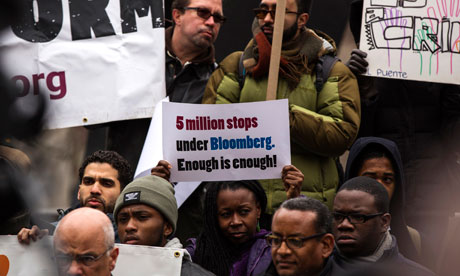
Demonstrators protest
the NYPD's stop-and-frisk police outside of Manhattan federal court last
month. Photograph: Lucas Jackson/Reuters
The commissioner of the New York
City police department views the controversial practice of stop,
question and frisk as a means to instil fear in young African American
and Latino men, a New York state senator testified in a federal court on
Monday.
State senator Eric Adams, who retired from the NYPD after rising to the rank of captain during a 22-year career, said commissioner Ray Kelly described his views on stop and frisk during a July 2010 meeting in the office of then-governor David Patterson.
Adams had traveled to Albany for a meeting on 10 July 2010 with the governor to give his support for a bill that would prohibit the NYPD from maintaining a database that would include the personal information of individuals stopped by the police but released without a charge or summons. In discussing the bill, which ultimately passed, Adams said he raised the issue of police stops disproportionately targeting young African American and Latino men.
Read on...
State senator Eric Adams, who retired from the NYPD after rising to the rank of captain during a 22-year career, said commissioner Ray Kelly described his views on stop and frisk during a July 2010 meeting in the office of then-governor David Patterson.
Adams had traveled to Albany for a meeting on 10 July 2010 with the governor to give his support for a bill that would prohibit the NYPD from maintaining a database that would include the personal information of individuals stopped by the police but released without a charge or summons. In discussing the bill, which ultimately passed, Adams said he raised the issue of police stops disproportionately targeting young African American and Latino men.
Read on...
NYPD on Trial: Police Say They Are Forced to Harass Kids in Order to Meet Quotas
Last week, NYPD whistleblowers Adhyl Polanco and Pedro Serrano, who
secretly recorded supervisors demanding that officers fill quotas,
testified in federal court that they were forced to violate the law to
meet numbers. “We were handcuffing kids for no reason,” Polanco
testified. The two officers are testifying in a class-action suit
targeting the NYPD's stop-and-frisk policy.
Quotas for NYPD activity are illegal under New York labor
law, but secretly recorded roll calls reveal supervisors pushing
officers to get "20-and 1," meaning 20 summonses and 1 arrest per month.
Monthly quotas also required five "250s," or street stops.
“There’s a difference between” the department’s policies on
paper and “what goes on out there,” in real life, Polanco told the
court.
Monitoring New York City’s Police
Mayor Michael Bloomberg of New York and Commissioner Raymond Kelly are apoplectic about a bill pending
in the City Council that would create the position of inspector
general, an official with broad powers to review the policies of the
nation’s largest police department. Given the department’s long history
of episodic misconduct, the idea is one whose time has clearly come. The
City Council should press ahead with the bill and be prepared to
override a veto by the mayor.
Mr. Kelly’s assertion that an inspector general might impinge on law enforcement — or somehow make the city less safe — is utter nonsense. It ignores the fact that inspectors general scrutinize other city departments as well as police departments in other cities and federal agencies like the F.B.I. and the C.I.A. Their job is not to run things but to recommend improvements. The assertion that oversight is unnecessary ignores not only history but also the present — the department’s increasingly problematic stop-and-frisk program. The program is the subject of three federal lawsuits. In Floyd v. the City of New York, plaintiffs argue that the department is stopping and frisking people on the basis of race rather than reasonable suspicion of criminal behavior.
Read on...
This is an editorial from the NYTimes. Tom
Mr. Kelly’s assertion that an inspector general might impinge on law enforcement — or somehow make the city less safe — is utter nonsense. It ignores the fact that inspectors general scrutinize other city departments as well as police departments in other cities and federal agencies like the F.B.I. and the C.I.A. Their job is not to run things but to recommend improvements. The assertion that oversight is unnecessary ignores not only history but also the present — the department’s increasingly problematic stop-and-frisk program. The program is the subject of three federal lawsuits. In Floyd v. the City of New York, plaintiffs argue that the department is stopping and frisking people on the basis of race rather than reasonable suspicion of criminal behavior.
Read on...
This is an editorial from the NYTimes. Tom
NYPD Spent One Million Hours, 440,000 Arrests on 'Marijuana Crusade'
NYPD marijuana arrests the 'frontline civil rights issue' of the 21st century
According to a shocking new report released Tuesday by the Drug Policy Alliance, in just over a decade the NYPD has used approximately 1,000,000 hours of police officer time to make 440,000 arrests for low-level misdemeanor marijuana possession, in what critics are calling "a frontline civil rights issue facing urban communities of color in the 21st century."
The report titled One Million Police Hours and authored by Dr. Harry Levine, Professor of Sociology at Queens College, estimates that those detained in New York City for marijuana possession between 2002 and 2012 have spent roughly 5,000,000 hours in police custody.
The NYPD should be spending their time building communities, not tearing them down, said gabriel sayegh, New York State Director of the Drug Policy Alliance.“For years, New Yorkers from across the state have organized and marched and rallied, demanding an end to these outrageous arrests. And now we learn that the police have squandered one million hours to make racially biased, costly, and unlawful marijuana possession arrests. This is scandalous,” sayegh stated.
Read on...
Police Union and NYPD Collaborated to Set Arrest Quotas
New York City's police union and the NYPD collaborated to set arrest quotas for officers, confirms an audio recording obtained by The Nation on Tuesday.
In the audio clip, recorded in 2009 by officer Adil Polanco, a union delegate argues for "20-and-1": a monthly quota for each officer of 20 summonses and one arrest. According to several police interviewed by The Nation, some officers are forced to "seek out or even manufacture arrests" in order to meet quotas and avoid department retaliation.
The audio could be used as evidence in Floyd, et al. v. City of New York, et al., a case that opened yesterday in federal district court, whose plaintiffs allege the NYPD's stop-and-frisk policy results in racial profiling. From The Nation:
The NYPD has just surpassed 5 million stop-and-frisks during the Bloomberg era. Most stops have been of people of color, and the overwhelming majority were found innocent of any wrongdoing, according to the department’s own statistics. And though the number of stops may have gone down recently—as pressure on the department and increased awareness of the policy has officers and supervisors thinking twice about how they employ the practice—the existence of quotas ensures that New Yorkers will continue to be harassed unnecessarily by the NYPD.
Read on...
In the audio clip, recorded in 2009 by officer Adil Polanco, a union delegate argues for "20-and-1": a monthly quota for each officer of 20 summonses and one arrest. According to several police interviewed by The Nation, some officers are forced to "seek out or even manufacture arrests" in order to meet quotas and avoid department retaliation.
The audio could be used as evidence in Floyd, et al. v. City of New York, et al., a case that opened yesterday in federal district court, whose plaintiffs allege the NYPD's stop-and-frisk policy results in racial profiling. From The Nation:
The NYPD has just surpassed 5 million stop-and-frisks during the Bloomberg era. Most stops have been of people of color, and the overwhelming majority were found innocent of any wrongdoing, according to the department’s own statistics. And though the number of stops may have gone down recently—as pressure on the department and increased awareness of the policy has officers and supervisors thinking twice about how they employ the practice—the existence of quotas ensures that New Yorkers will continue to be harassed unnecessarily by the NYPD.
Read on...
Demonstrators Met With Riot Police, Arrests at Vigil for Brooklyn Teen Shot by Police
Heavy police presence, "media blockout" continue in days following shooting of Kimani Gray
 Police
officers arrest a demonstrator during a march after a vigil held for
Kimani "Kiki" Gray in the East Flatbush neighborhood of Brooklyn,
Wednesday, March 13, 2013, in New York. (AP Photo/John Minchillo)
Police
officers arrest a demonstrator during a march after a vigil held for
Kimani "Kiki" Gray in the East Flatbush neighborhood of Brooklyn,
Wednesday, March 13, 2013, in New York. (AP Photo/John Minchillo)
Demonstrators gathered for a third night in a row in the East Flatbush neighborhood of Brooklyn Wednesday night over the shooting of 16-year-old Kimani Gray by the NYPD over the weekend. Residents from the area who marked the evening with another protest and candlelight vigil were met once again by riot police—who arrested up to 50 protesters in the area including Gray’s sister.
Sophie Lewis at In These Times reports that the "whole of East Flatbush is becoming a so-called Frozen Zone: an unofficial NYPD tactic of totally excluding the media from an area."Lewis reports on the scene Wednesday night:
Read on....
NYPD Policy Will Deter Reports from Domestic Violence Victims
As if being beaten within an inch of their lives wasn't enough, now
domestic violence victims can be jailed if they have an open warrant and
report their beating to the police.
The New York Post reports that NYPD cops are required to run criminal background checks on victims of domestic violence.
Women who report domestic violence are exposing themselves to arrest under a new NYPD directive that orders cops to run criminal checks on the accused and the accuser, The Post has learned.
The memo by Chief of Detectives Phil Pulaski requires detectives to look at open warrants, complaint histories and even the driving records of both parties.
“You have no choice but to lock them up” if the victims turn out to have warrants, including for minor offenses like unpaid tickets, a police source said.
Read on....
The New York Post reports that NYPD cops are required to run criminal background checks on victims of domestic violence.
Women who report domestic violence are exposing themselves to arrest under a new NYPD directive that orders cops to run criminal checks on the accused and the accuser, The Post has learned.
The memo by Chief of Detectives Phil Pulaski requires detectives to look at open warrants, complaint histories and even the driving records of both parties.
“You have no choice but to lock them up” if the victims turn out to have warrants, including for minor offenses like unpaid tickets, a police source said.
Read on....
To Stem Juvenile Robberies, Police Trail Youths Before the Crime

Todd Heisler/The New York Times
John Rivera, 19, during a New York Police Department juvenile intervention program visit.
Three police officers knocked on the apartment door of a 15-year-old boy.
He had already been on both sides of a police blotter: shot and
stabbed, but also arrested on robbery charges. He ran in an East Harlem
gang and lived with his grandmother on the seventh floor of a public
housing building, where the stairwells reeked of marijuana.
He was the type of teenager destined for trouble. And that was precisely
why the officers were at his door on a recent winter night.
The New York City Police Department
has embarked on a novel approach to deter juvenile robbers, essentially
staging interventions and force-feeding outreach in an effort to stem a
tide of robberies by dissuading those most likely to commit them.
This Is What a Police State Looks Like: 7 Yr Old Interrogated, Handcuffed for Hours over $5.00.
You see, it was all done 'by the book.' according to NYPD.
What does the book tell a police officer to do when a seven year old gets into a fight with another seven year old over $5.00?
Read on...
... children seven to 17 can be charged as juveniles. "Everything was done properly," the unidentified cop told the News.
What does the book tell a police officer to do when a seven year old gets into a fight with another seven year old over $5.00?
Officers showed up at PS X114 on Dec. 4 at about 10:20 a.m., and handcuffed and held ((7 year old)) Wilson in a room there for four hours. They then hauled him off to the 44th Precinct station house for another six hours of interrogation and verbal abuse...What does the book tell police to do with seven year olds when they are hauled down to the station?
Read on...
The homeless man, the boots and the complex story behind the viral photo

A picture is worth a thousand words, as the cliché goes. But are a thousand words enough to tell the whole story?
Not in the case of the viral photograph that recently emerged from the streets of Manhattan. The image has now become a familiar one: a New York City police officer kneels beside a barefoot homeless man in Times Square and offers him a new pair of boots.
The officer, Larry DePrimo, did not know an Arizona tourist had captured the moment with her cellphone. The photo was uploaded on Facebook and rocketed around the web, garnering 1.6 million views in 24 hours and riveting the media: The officer bought the boots with his own money! The shoe store employee was so touched he gave a discount! The cop keeps the receipt in his vest as a reminder of those who are less fortunate!
The image was powerful in its simplicity. But as more details emerged, the story grew more complicated — and negative toward the man who asked neither for the boots nor for the attention that came with them.
Read on...
Don't think any of this changes the sentiment of the original story. Tom
Not in the case of the viral photograph that recently emerged from the streets of Manhattan. The image has now become a familiar one: a New York City police officer kneels beside a barefoot homeless man in Times Square and offers him a new pair of boots.
The officer, Larry DePrimo, did not know an Arizona tourist had captured the moment with her cellphone. The photo was uploaded on Facebook and rocketed around the web, garnering 1.6 million views in 24 hours and riveting the media: The officer bought the boots with his own money! The shoe store employee was so touched he gave a discount! The cop keeps the receipt in his vest as a reminder of those who are less fortunate!
The image was powerful in its simplicity. But as more details emerged, the story grew more complicated — and negative toward the man who asked neither for the boots nor for the attention that came with them.
Read on...
Don't think any of this changes the sentiment of the original story. Tom
Larry DePrimo, NYPD Cop, Buys Homeless Man Boots

"I had two pairs of wool winter socks and combat boots, and I was cold," DePrimo, 25, said Wednesday, recalling the night of Nov. 14, when he encountered an unidentified, shoeless man on the sidewalk on Seventh Avenue near 44th Street.
DePrimo offered to get him socks and shoes.
"I never had a pair of shoes," the man replied, according to DePrimo, who's assigned to the Sixth Precinct and has been on the force nearly three years.
Read on...
Subscribe to:
Posts (Atom)